Hospitality design through the eyes of the Ippolito Fleitz Group
Aufgenommen: Ippolito Fleitz Group, Büro Berlin, Berlin
 Germany48 Min
Das Video kommt von YouTube und lädt erst, wenn du auf Abspielen klickst.
„the design process is really about the narrative. So you're creating an experience and a lifestyle through that unique narrative that is based on parameters such as the place and the culture“
Tomás Contreras & Jana Iszatt, 15:33
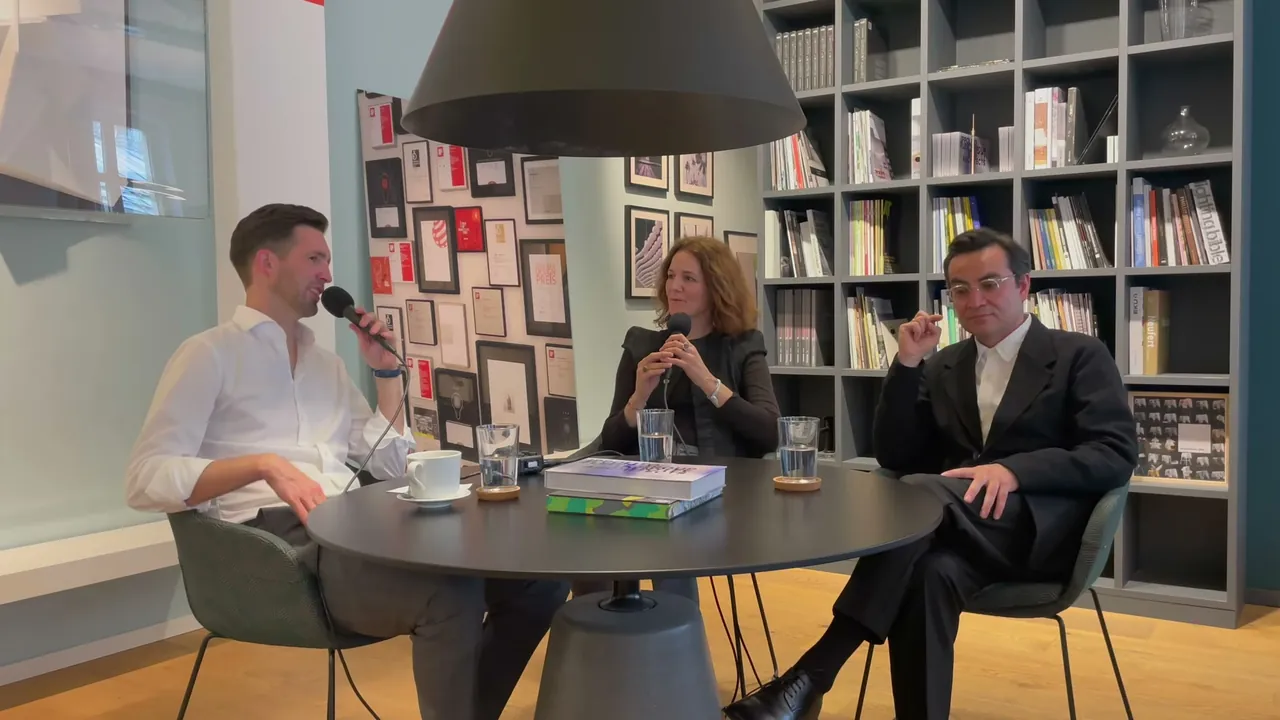
Ronald M. Arndt besucht Tomás Contreras und Jana Iszatt im Berliner Büro der Ippolito Fleitz Group. Beide haben lange in Asien und im Nahen Osten gearbeitet, Jana in Singapur, Tomás in Shanghai, und erzählen, wie sie aus Ort, Kultur und Geschichte eines Hauses ein Narrativ bauen, aus dem das Design entsteht. Konkret wird es beim Thema Wellness, beim Kunstbudget und bei einem Projekt im Schwarzwald, wo ein Investor aus Thailand einsteigt.
Die Audiodatei kommt beim Abspielen von Spotify for Creators. Vorher wird nichts geladen.
Kernaussagen
- Narrativ vor Design: Jana baut den Designprozess um eine Erzählung, die aus Ort, Kultur, Geschichte und den Menschen vor Ort entsteht. Erst daraus folgen Erlebnis und Gestaltung, und das macht jedes Projekt unterscheidbar.
- Back of House mitrechnen: Tomás achtet darauf, dass das Verhältnis von Back of House zu Front of House stimmt. Wenn alles ins Erlebnis fließt, werden öffentliche Flächen und Nebenräume zu groß und der Eigentümer bekommt seinen Return on Investment nicht.
- Motel One als Vorbild: Tomás nennt Motel One als Haus, das Public Spaces verstanden hat: im Zimmer nur das Nötige, dafür werden Gäste in die öffentlichen Flächen geschoben. Geschäftsreisende nutzen diese Flächen stärker als Leisure-Gäste, weil sie weniger Zeit für die Stadt haben.
- Kunstbudget entscheidet: Jana hat beim Planungsarchitekten von Motel One gearbeitet und dort deutlich mehr Budget für Kunst im öffentlichen Bereich gesehen als bei Marcel Wanders in Amsterdam, wo jedes Detail schon durchgestaltet war. Sie arbeitet gern mit lokalen Künstlern, von Weberei bis Keramik.
- Schwarzwald trifft Thailand: Ein Investor aus Thailand steigt bei einem Haus im Schwarzwald ein. Die Familie hat drei aktive Brüder, alle mit Asiatinnen verheiratet, und die jüngere Generation will nicht übernehmen, deshalb war die Offenheit für den Käufer groß.
Shownotes zur Episodeaus dem Podcast-Feed
Not only does this episode introduce HOTEL-PODCAST.COM to the Middle-East and Asia but it also welcomes an exciting brand within HOTEL-COLLECTIVE.COM. Curtains up for the Ippolito Fleitz Group!
With more than 20 years of work experience in several markets, Tomás Contreras and Jana Iszatt greeted me at their Berlin office. We talked about the differences between hospitality design in Europe and other regions, but also what it actually meant to them to have worked in other countries for such a long time?
They explained to me their conceptual approach of how to bring a (new) story to life in order to make a hotel unique. What was even more exciting, I learned what this process looks like with a current project in the Black Forrest and how the Ippolito Fleitz Group brings in their connections from all over the world.
Having started their adventures in Stuttgart in 2002, the companys’ founders Peter Ippolito and Gunter Fleitz had always wanted to go abroad. Today they’re truly international with offices not only in Germany, but even in Shanghai, Moscow and Zurich.
I’m really looking forward to our joint journey through the world of hospitality.
Keine Episode verpassen
Folge HOTEL-PODCAST dort, wo du sowieso hörst. Neue Episoden aus sechs Ländern kommen dann ganz von selbst. Oder tritt unserer WhatsApp-Community bei, um über alle Neuigkeiten auf dem Laufenden zu bleiben.
Weitere Episoden
Alle Episoden
Transkript
Transkript öffnenTranskript schließen48 Min · Ronald M. Arndt und Tomás Contreras & Jana Iszatt
Automatisch transkribiert mit AssemblyAI, Sprecher automatisch zugeordnet. Nicht redigiert.
- 00:07 Ronald M. Arndt
So, great, another Hotel-Podcast in English today. Why English? I think because you're quite an international office, or not office, company, and because I'm from Stuttgart, from the Swabian region, and perhaps you might not understand my German here in Berlin. But what I can see behind you, it's very nice. It's the Stuttgart Television Tower, so that I can see from my kitchen window actually.
- 00:35 Jana Iszatt
Oh wow. Really?
- 00:36 Ronald M. Arndt
So now I'm sitting here. Yeah, took me 6 hours. I just arrived. It was the first time that I arrived in Berlin and I didn't feel cool, uh, cool, cold, cold, cold actually. Yeah, so let's start, huh? Hotel-Podcast. at Ippolito Flights. Really looking forward to our episode today. Jana and Tomás, who are you and what do you do here at Ippolito Flights?
- 01:05 Jana Iszatt
Hi, I'm Jana and I'm specialized in hospitality design, really. So I came into the company to work as a consultant to guide the design process of hospitality projects. And I've worked on a lot of larger-scale projects, especially in Asia and the Middle East and so on. So, so Tomás and I have a similar background in regards to region and also a previous connection. So it's great that we met up again in this part of the world.
- 01:44 Ronald M. Arndt
Yeah.
- 01:44 Jana Iszatt
Yeah.
- 01:45 Ronald M. Arndt
Well, you both are real hospitality guys in architecture and design.
- 01:49 Tomás Contreras
That's correct. We're both in the same boat, actually. It's been an interesting journey. And Jana somehow has kind of showed up just recently. But actually, we are connected maybe for the last 15 years, I would say, because we were both, as Jana mentioned, in Asia. Jana was in Singapore. I was in Shanghai.
- 02:10 Ronald M. Arndt
Okay.
- 02:10 Tomás Contreras
We both used to work for large international firms.
- 02:13 Ronald M. Arndt
Yeah.
- 02:13 Tomás Contreras
And we switched into a context where everything is more boutique. The scale is smaller, but attention to detail as well is a lot more.
- 02:21 Ronald M. Arndt
Okay.
- 02:21 Tomás Contreras
So yeah, and regarding myself, a little introduction. So I'm with Hipólito Flats already almost 3 years. I came to grow our studio and we have a floor upstairs right now, a lot more energy and enthusiasm as well, and a different commercial platform than the one that we operate, a larger portfolio of clients, and as well an intention to enter into international markets that we actually I think it's actually happening. We are now entering into Asia more aggressively and as well the Middle East, and Jana came really to support us in that growth.
- 02:56 Ronald M. Arndt
Okay. So, and Peter Ippolito and Gunther Fleitz, I think they started the company in 2002 in Stuttgart, so where I come from. So I'm still looking for Peter, as I always thought that he's one of my neighbors, but I never can see him. So we have to discover discuss this afterwards. And when did you start working in hospitality? Is this a new segment, or—
- 03:24 Jana Iszatt
When I started—
- 03:25 Ronald M. Arndt
Are you pleased with it? It's your first project, hotel project?
- 03:29 Jana Iszatt
I mean, I've done some smaller projects. Yeah, we started 2 years ago in May. And yeah, so it's increasingly growing. But we're also actively trying to network and get into this part of the world. As I mentioned to you before, I was born and brought up in Germany, but then left in '99 and just came back 3 years ago.
- 04:00 Ronald M. Arndt
So a long time abroad, huh? From '99 until 3 years ago?
- 04:04 Jana Iszatt
Exactly.
- 04:04 Ronald M. Arndt
So where did you live before?
- 04:06 Jana Iszatt
I first went to London because my dad is English, actually. And yeah, just design, art, music, fashion. I studied there. there, then spent the majority of 10 years there, brief stop in New York, then Amsterdam, Singapore, and then back here. Yeah, but then it was COVID, so it's been a slower process, but I feel now it's, you know, accelerating.
- 04:33 Ronald M. Arndt
Yeah. And you've got an international background as well, I imagine?
- 04:37 Tomás Contreras
That's correct. My father is Spanish, my mother is Chilean. I was born in Santiago. I lived there until 17. At 17, I got a scholarship. I went to Domus in Milan to do my I got engaged with 2 very important figures in my life, one of them Ian Trager, the second one Philippe Starck. They took me to a project in Argentina.
- 04:57 Ronald M. Arndt
Okay.
- 04:58 Tomás Contreras
From the school in Milan directly to Buenos Aires. I was the only student who spoke Spanish actually, so I could help them into a project. I got engaged with the hospitality market, basically in love with the hotel work. I went to London, worked with GA, and from GA in London to Japan, did 2 projects there, the Conrad and as well the Sunrise in Osaka. decided to move forward with Gensler, which is a much larger corporation, largest, I think, in the world. And then I went with them to Shanghai, LA, and worked internationally. I think it was an excellent experience who helped me to understand the nuances between the market, the different markets, and the importance to understand how the perception of what hospitality is around those.
- 05:41 Ronald M. Arndt
I think that's a very interesting point.
- 05:44 Tomás Contreras
We definitely—
- 05:45 Ronald M. Arndt
so that you know the different views on the topic.
- 05:47 Tomás Contreras
That's been really insightful for me and for the people around. I think what is crucial is the fact what you were mentioning about Peter and Gunther. I think maybe I will get back to them here because I think there's a very particular essence around our organization. And it comes from the fact that they're definitely very curious. Different to many other actors in the market, they, from the very beginning, they decided to go abroad. And the point, the meeting point for us was when I was working with Emaar, which is a large developer in Middle East.
- 06:22 Ronald M. Arndt
Yeah.
- 06:23 Tomás Contreras
And Mohammed Alabbar, the owner, and the Ministry of Economy and the ambassador of UAE in Uzbekistan invited me to check some properties there. And one of the properties that was in question was a property designed by them.
- 06:36 Ronald M. Arndt
Okay.
- 06:36 Tomás Contreras
So it was there in the meeting point and they said, well, we know these crazy Germans who did, you know, this hotel, this government palace in 4 months. And I went like, I mean, that's—
- 06:47 Ronald M. Arndt
Where was the palace?
- 06:48 Tomás Contreras
In Uzbekistan?
- 06:49 Ronald M. Arndt
Uzbekistan.
- 06:50 Tomás Contreras
Tashkent, which is the capital. And it was like, you know, I went like, that's impossible. But actually it was. So I went to visit them and then the relationship started. And since I'm married to a German lady and we have a 6-year-old, we decided—
- 07:04 Ronald M. Arndt
Who married you as fast as your Yeah, that's correct. She gave you 4 months.
- 07:11 Tomás Contreras
Yeah, that's correct. But well, finally we ended up here and I think it's been a good collaboration and I think it's bringing opportunity to a large international team, people from all different places that's now exploring adventures in other countries with us.
- 07:28 Ronald M. Arndt
So we mentioned Berlin, of course, where we are at the moment. but also Stuttgart, where the company has been founded. But you even have an office in Shanghai.
- 07:36 Tomás Contreras
And we are actually opening one in Thailand as well.
- 07:39 Ronald M. Arndt
In Thailand?
- 07:40 Tomás Contreras
Okay. So we see an opportunity in the South Asian market, not only to explore the market there, but to support our projects here as well.
- 07:46 Ronald M. Arndt
Okay.
- 07:46 Tomás Contreras
Yeah.
- 07:48 Ronald M. Arndt
So please repeat, you don't want to develop hotels in Thailand, but—
- 07:52 Tomás Contreras
We definitely want, but I think the biggest focus is now bring the sense of wellness and Asian hospitality into other markets. And I think how the best way to really apply that formula is engaging with people that work in that market for years, you know, and they have the experience on developing brands like Aman, you know, and other brands, Acid, you know, which are very important actors on a very crafted sense of wellness that I think will be very insightful for this market.
- 08:28 Ronald M. Arndt
Okay.
- 08:29 Tomás Contreras
Nevertheless, the German market has really good particularities that we as well trying to extrapolate to other markets. But I think that's the intention, to try to bring our brand definitely as well into other markets and bring the talent from other markets into our market.
- 08:42 Ronald M. Arndt
So you mix the best products or talents between the markets.
- 08:48 Tomás Contreras
It's an important exchange. Post-COVID, it has been a sense— there is a sense of clusters. I think it's a positive thing. as well on that. But I think it's important exchange, and for us as designers, I think that exchange is really what makes our work meaningful. So yeah, I think Jana, I'm sure, is totally agree with me now.
- 09:06 Jana Iszatt
Yeah, I mean, I think generally work— working across different countries with people with different strengths and a pool of knowledge is super helpful. And so I've been working like this actually for the past— I mean, I was in Asia for a long time, but since I came back, it's been a mix working between the different continents. And there's a lot of large-scale projects in Asia. And as Tomás mentioned, the kind of level of hospitality and wellness, it's a different—
- 09:45 Tomás Contreras
Yeah.
- 09:48 Jana Iszatt
level than it is here. So I think to combine those forces and work with people from everywhere really, you know, brings out the best essence.
- 09:58 Ronald M. Arndt
So in the end, you even have to bring the people over here for the treatments.
- 10:03 Jana Iszatt
For the treatments, yes, exactly, definitely.
- 10:07 Ronald M. Arndt
You can have a nice hotel with good, nice spa area, right?
- 10:13 Jana Iszatt
Yeah, I mean, I think the topic of wellness generally, also post-COVID, is super interesting. Because I think it's growing from a hotel just having a spa to having a really more transformative and curated experience. And I mean, yes, people want to travel and catch up with everything they haven't done in the past, but I think people are also— they think more about what they really want to do. So it's more selective. So there might be really big trips, but I think also the trend to explore local areas that are not too far away is really big. I mean, just to get out of the city, connect with nature. So I think that in this DACH region also, I mean, we have so much of beautiful mountains, lakes, nature, and all of that. So I think for the locals, it's super interesting. And definitely in Asia, everyone, you know, all my Asian friends have been traveling more places in this region than I have because they all want to go to the Black Forest. And I mean, there's particular like Schloss Schwanstein obviously, but there's also other areas. So I think it's also an international market.
- 11:31 Ronald M. Arndt
Yeah, but it's a nice idea to improve the spots and the hotels and the products you have that are not too far away.
- 11:40 Jana Iszatt
Exactly.
- 11:41 Ronald M. Arndt
So that in the end you don't have to take the plane all the time.
- 11:43 Jana Iszatt
Exactly.
- 11:44 Ronald M. Arndt
But spend shorter or longer weekends in different places just around here. Yeah, I mean, that's why you have to improve the products and especially the spa.
- 11:56 Tomás Contreras
Yeah.
- 11:56 Ronald M. Arndt
Okay.
- 11:57 Jana Iszatt
Yeah.
- 11:58 Ronald M. Arndt
Tell me, what's the big difference between a spa, how do you call it, spa in a hotel in Asia and here in Germany? Does it feel completely different or?
- 12:09 Jana Iszatt
I think I'm not so familiar, like growing up here in Heidelberg, there's not much of a spa culture, but then I know there's Baden-Baden and even in Frankfurt there's lots of Badehäuser and so on, which are great, but it's very different because in Asia, I mean, as everyone knows, you can have like amazing massage for little money.
- 12:35 Tomás Contreras
Yeah.
- 12:36 Jana Iszatt
So if you're going to a more luxurious hotel, Hotel, the spa treatment is, it's very, very unique and individualized.
- 12:46 Ronald M. Arndt
And yeah, that's why I said you always need the people, no?
- 12:49 Jana Iszatt
Yes, you need people. Exactly. You need skilled people and they, yeah. And, but I think there's enough skilled, if you have the training, then you can apply it. You need a good teacher.
- 13:02 Ronald M. Arndt
Like, if you have the product, then you will also find somebody to Yeah, but I think also it's—
- 13:09 Jana Iszatt
it can be a very exclusive experience for yourself, but it also— I feel that the market is opening up, that it's not just about you and your private, you know, treatment room.
- 13:22 Ronald M. Arndt
Yeah.
- 13:22 Jana Iszatt
But maybe it's, it's a bit of a mix of this German sense and, and the Asian. That could be really interesting. So you can decide because People want to kind of have their moment and have some salvation from the busy lifestyle, but they also want community more than ever. So, and I think we're not just talking about spa and wellness, it's like mental wellness, it's mindfulness. I think there's a really, yeah, it's a really big market. I mean, a lot of people actually need it to be able to deal with their crazy—
- 14:03 Ronald M. Arndt
Mm-hmm.
- 14:04 Jana Iszatt
crazy work life. So, yeah.
- 14:07 Ronald M. Arndt
So what do you think in general? You have to convince the hotelier that there are so many different approaches? So there are so many new other ideas coming from abroad? Or do you think that hoteliers from a newer or younger generation, they're really already looking for your ideas?
- 14:30 Jana Iszatt
I think the younger generation is also looking for that.
- 14:34 Ronald M. Arndt
Because they already traveled a lot.
- 14:36 Jana Iszatt
They traveled a lot, but also this kind of sustainability factor. So as you said, don't take the plane. You know, if you, if you really, if you have like a bucket list, obviously you want to get to some of these amazing places. The wild—
- 14:51 Ronald M. Arndt
so bucket list: Heidelberg, Black Forest, Bodensee.
- 14:54 Jana Iszatt
It's also great if you Just, you know, get away for a few days and have something similar. So I'm pretty sure enough people are aware of that. And a lot of— I mean, I'm not as familiar with the market here as you are right now, but I think transformation— a lot of people are looking for transformation and also operators. So yeah.
- 15:20 Ronald M. Arndt
Yeah, I think a lot of Yeah, family-run hotels have to not only improve but reinvent the product as well. So they need to find a new story.
- 15:33 Jana Iszatt
Yeah, so I think now that you said story, to me it's a lot about the design process is really about the narrative. So you're creating an experience and a lifestyle through that unique narrative that is based on on parameters such as the place and the culture, and you really get into the location and you kind of form a story that makes it unique. And then the design—
- 16:04 Ronald M. Arndt
So you start much earlier. So it's not only the spa, but perhaps you even find a new brand or—
- 16:10 Jana Iszatt
Yeah, and for each location you kind of have these parameters. So it's not too obvious in your face, but I think from a design perspective, to me, it makes it a lot easier to have meaning and a certain connectivity within a project.
- 16:30 Ronald M. Arndt
How much time do you need to get a feeling, an idea of a new hotel?
- 16:37 Jana Iszatt
I mean, Coming from Asia, more or less, we're pretty fast, I think.
- 16:43 Ronald M. Arndt
Okay, because they are very fast?
- 16:46 Jana Iszatt
Yes, I mean, it's a different speed for sure, working, yeah, working a lot and fast. But I mean, if you have a good team and you brainstorm together, and I mean, this is also the fun part, to look at a project, a property, and the surrounding area, the history, the people, like all of this. the DNA. And to then come up with stories and be creative is really the most fun part. And also, I find working within given restrictions, making the issue into something special is also—
- 17:24 Ronald M. Arndt
So restriction might be space or budget or—
- 17:28 Jana Iszatt
Yeah, all sorts of different things. I mean, I've worked a lot in high-end luxury, but I also worked on a number of smart hotels in China that were 3 stars, or, you know, there's different— I think that as a designer, what's interesting is that you can design within the parameters, and it's as long as the brief is clear, then you're trying to find a solution.
- 17:51 Tomás Contreras
Yeah.
- 17:52 Jana Iszatt
So the challenge becomes the interesting point and makes it unique. And I think you can do a very simple design, but then you bring in some interesting artwork or, you know, like, accents, and you can twist the whole story. So I think that to me is what makes it interesting and unique, is that every project is different, every property, every owner, every location.
- 18:19 Ronald M. Arndt
Okay.
- 18:19 Jana Iszatt
So yeah.
- 18:20 Ronald M. Arndt
So coming back to your services, or I don't know if you call them services, but yeah, it's possible that you even work on the brand as well, a little bit?
- 18:31 Tomás Contreras
It's an interesting question. As Jana was describing her experiences and what we're facing here, I was thinking actually on that. I was thinking in the—
- 18:39 Ronald M. Arndt
So a whole package, 360 degrees.
- 18:41 Tomás Contreras
Correct. And then the fact that we see intention here on many small owners and medium scale as well on developing their own brands and crafting those experiences to be unique. And we're actually working on 2 projects that are on that scale. And yeah, I see their interest into explore and into use as well our experiences and to craft those brands. And I think that is definitely a trend. I see it as well in other markets. I see, I participate in one of them in Middle East working with Emaar where they develop actually 3 major brands, 5, 4, and 3 stars. And those are growing as well internationally. So I think there is an opportunity. There is a— to explore new territories, create new narratives. But as well, I see the international hotel operators trying to become more crafted and enhancing their brand portfolio in order to feed that need for millennials as well that are actually looking for, I would say, instant satisfaction, which on the old products is more difficult to be obtained. So I think the capacity for the teams to understand that need, understand the market needs and respond quickly to those is crucial as well. But I see as well the value that we can offer as a German firm into international sector, other markets where our processes as well are from a design intelligence perspective, a lot more efficient, I would say, you know, and as well our cost seems to be very competitive. So helping the owners to create properties that are Very intelligent from an experiential perspective, but even more intelligent when evaluating costs and the relationship between back of house and front of house is the adequate relationship. So making sure that the owners will get the return on investment that they need. Because if we let go, you know, everything to experiences, then our public spaces might be massive and as well as the back of houses. So I think we need to be intelligent and responsible to give them the best outcome.
- 20:48 Jana Iszatt
Yeah.
- 20:48 Tomás Contreras
The most efficient one.
- 20:49 Ronald M. Arndt
Okay.
- 20:49 Tomás Contreras
So that would be my answer to it.
- 20:51 Ronald M. Arndt
Cool. And how big is your team at the moment? So working in hospitality?
- 20:54 Tomás Contreras
Now we have 3 offices, major offices, as you mentioned, Stuttgart, Berlin, and Shanghai. The office in Berlin is focused on lifestyle.
- 21:03 Ronald M. Arndt
So that means hospitality, but also restaurants or shops?
- 21:08 Tomás Contreras
That's correct. So we have F&B, and as well we have high-end residential. which touch on service apartments. And so I think our team went from 2020 being 9 to 10 to 24 right now. So it's been a big push and to explore other markets, but now we need to maintain the base. So now it's a good message for all the owners that are looking for— here we are to help.
- 21:34 Ronald M. Arndt
Yeah. So, and you even worked on the club restaurant from the VfB Stuttgart, so my soccer team from Stuttgart. So that's Yeah, I found out on your website.
- 21:43 Tomás Contreras
Yeah, that's right.
- 21:44 Ronald M. Arndt
And then amazing.
- 21:45 Tomás Contreras
Yeah, I think, I think F&B is really a key element for us. I think it's a starting point for Peter and Günther.
- 21:52 Ronald M. Arndt
I think it's a starting point for them, but also starting point a little bit to get into the business.
- 21:57 Tomás Contreras
Yeah, yeah. You might have a lot of insights, but I think here in Germany, F&B is a very specific one. I really love it because I think there is attention on every detail. So it's a very insightful market to be in, I will say. And our team now is divided here in Berlin to be even more clear regarding what the team is doing. We have 3 major sectors and we have a specific expertise in every sector. So we have someone taking care of the practice area on F&B, which is only focused on that.
- 22:27 Ronald M. Arndt
Yeah.
- 22:27 Tomás Contreras
And then we do the same with hotels. And Jana is actually working over all the sectors supporting the teams to deliver the best design possible.
- 22:35 Ronald M. Arndt
Okay. Just to close this chapter, it wasn't only the VfB Stuttgart restaurant, but also the Motel One restaurant on their campus. So very big name already in hospitality that you're working for.
- 22:50 Tomás Contreras
Yeah, I'm super, super proud of that because I think Motel One is doing great and I think they understood that actually public spaces are very important. So they offer the very minimum necessary in the guest rooms. You know, you have a perfect stay on them.
- 23:07 Ronald M. Arndt
Yeah.
- 23:07 Tomás Contreras
But you use, you are pushed to use the public spaces, to share, to eat, to enjoy, to exchange, you know? So I think that's definitely not only a trend, but a need. And if we look at the market right now and we think on what the leisure versus business travelers do, we see that business travelers use a lot more the public spaces because they have less time. to experience the city. So they use the hotel facilities a lot more than what the leisure travelers do, which have time to explore the city as well. So I think Motel One did it perfectly. And if we look at that and we come back to your point on how we can advise owners, I think that is the sort of intelligence that you want to have in your team when you're designing a brand. Can I add something to that? Yes, please.
- 23:52 Jana Iszatt
So I actually briefly worked for the planning architect of Motel One in between, and this was after I was at Marcel Wanders in Amsterdam, and it was really interesting. I mean, first of all, what Thomas mentioned, the whole calculation of back of house, front of house, because to me I was always front of house, was super interesting. But also the rooms are designed in such a smart way that it's all about numbers, so you can actually buy a more expensive product because you're multiplying it. But also the budget that was left for art, for example, in public spaces was so much higher than what we had at Marcel Wanders because we already were— I mean, not ran out of budget, but, you know, everything was designed, every detail everywhere. So we actually never had much left for art. So I thought that was really interesting and combining exactly that knowledge because yes, it is about an experience, but it also needs to be realistic because otherwise it's not a product that is complete in itself. But you can be really smart about these things and what's the focus and where do you need an accent and what parts Parts can be, you know, a bit simpler. So I think it's always about that balance. Yeah.
- 25:20 Ronald M. Arndt
Okay, so if you say art, then you mean that you really buy the, the, the canvas or the paintings, or?
- 25:27 Jana Iszatt
Yeah, I mean, we've done like— I've also worked on a lot of art.
- 25:32 Ronald M. Arndt
I know hotel chains that print the books on the, on the wall, but that's very—
- 25:36 Jana Iszatt
For the big projects that, um, that we've done, that I've done in the past, There was, yeah, Kimpton Hotel, for example, or Intercontinental. I mean, both in Asia, we did the art package as well, where we—
- 25:51 Ronald M. Arndt
I really have to get to know this because now the Hotel Podcast goes Asia. So, okay, I really have to write that down though.
- 25:58 Jana Iszatt
So, so we actually also did an art package, um, in which the, the conceptual approach of the art and also how that could be done. So it's kind of a collage of, um, a sculpture, but it has this influence, and then maybe you build a 3D or something, and then you get somebody to actually produce the art. But then you also have artists that you like. Um, I mean, I think this is super interesting always in projects if you, if you work with local artists. And, you know, it could be the craft of how they're weaving something.
- 26:34 Ronald M. Arndt
Yeah.
- 26:35 Jana Iszatt
It could be a photograph. I mean, there's so many different ways. It could be ceramics. And to either have that as an artwork or have it as a detail as part of your, I don't know, table or furniture or whatever element is super interesting. And that's also what makes it unique. So I think art in general to me is really important.
- 26:59 Ronald M. Arndt
Right.
- 26:59 Jana Iszatt
Yeah, but to have a budget, I mean, you don't want to copy things, obviously.
- 27:04 Ronald M. Arndt
No.
- 27:05 Jana Iszatt
to support the artists. So it's important that, you know, you know, what do you want to, like, budget-wise, how are you, you know, planning that to allow for these special features? Yeah.
- 27:19 Tomás Contreras
Somehow I feel, yeah, that the region is young on those terms. When we go to more evolved markets in the hospitality industry, we see that our consultancy is really a practice, and you engage with our consultants consultants in order to support you through the process. And I think in here, we're trying to craft those teams actually as well to make part, to have a holistic offer as well. Because as Jana said, I think in order to offer a unique guest experience, art is relevant from a narrative perspective. You want to drive your guests into any story and to complete that story.
- 27:51 Jana Iszatt
Yeah.
- 27:52 Tomás Contreras
Art is the, you know, at the top of the cake. So, yeah. But yes, budgets. Art is always a challenge in that regard, depending on how ambitious it is. And I see that we designers are very ambitious, of course, always in what we want to achieve. And then balance is important. So yeah, again, maybe the relationship between different markets is important as well to bring those stories crafted for other markets as well. Maybe artists as well need support.
- 28:21 Ronald M. Arndt
Mm-hmm.
- 28:21 Tomás Contreras
I'm a big believer of a concept of internationalization without necessarily being us moving to a different sector, but actually bringing those experiences from other markets into this market and the opposite. And I think we have a large responsibility into work on that, all of us. I think the world is becoming one somehow, and I hope that will be a trend as well. So for the products that we are developing.
- 28:50 Ronald M. Arndt
Okay. So in general, you see a lot of increasing interest in investing in hotels in the DACH region?
- 28:58 Tomás Contreras
I perceive that there is a major interest from hospitality investors in other regions. We have the experience now, I think, with one of them in Southeast Asia, which is Yeah, extremely active here, and we're helping him actually, and to take that adventure into the Black Forest with wonderful clients, actually.
- 29:25 Ronald M. Arndt
I think there are so many nice smaller hotels or even bigger hotels, the next generation doesn't want to take over.
- 29:33 Tomás Contreras
Exactly, that's correct. And I think the new brands are actually being crafted specifically for those markets.
- 29:40 Ronald M. Arndt
So a totally new brand, you mean?
- 29:42 Tomás Contreras
Absolutely.
- 29:43 Ronald M. Arndt
Okay.
- 29:43 Tomás Contreras
Yes.
- 29:44 Ronald M. Arndt
And you start with a blank sheet of paper.
- 29:46 Tomás Contreras
Yeah. I mean, I think there is an intention, of course, that comes from their experience. And then, you know, when taking a new property and a new landscape and a new context, I think they have to readapt those. And we're helping them through that experience. So we learn.
- 29:59 Ronald M. Arndt
Okay.
- 30:00 Tomás Contreras
But the most interesting part for me has been to see the dynamics between the— normally those, the investors are family investors, you know, groups.
- 30:08 Jana Iszatt
Yeah.
- 30:08 Ronald M. Arndt
And as well, they are from abroad, investors in general.
- 30:11 Tomás Contreras
Yes, yes. In this case, it's a South Asian investor from Thailand that I think is extremely receptive. But I think there is a major willingness from owners here as well to open the doors to that investment and as well to knowledge and to experiences. So I'm hopefully looking to a market that will become super international, even in areas Okay. Like the Black Forest, no? So I think that's extremely interesting.
- 30:37 Ronald M. Arndt
I try to imagine how a family, traditional family from the Black Forest meets the potential investor from Asia. But do you think the family from the Black Forest stays on board or?
- 30:53 Tomás Contreras
Very interesting question. And we are through the process right now. What I've seen through the process, what I learned is like, Because it would be a tremendous job. It's a family that has a few brothers, 3 brothers that are very active in the business. And funnily enough, they're married all to Asians. So in this case, it wasn't difficult to explain the nature of the business. And they were extremely receptive and happy to find someone who will have the interest to take care of the property because the other generations, the younger generations, their sons and they're kind of—
- 31:28 Ronald M. Arndt
So women take over.
- 31:29 Tomás Contreras
Yeah. So I think it's— yeah, that's correct. And I think that's been for us a total positive shock somehow. And we're working through a process and—
- 31:41 Ronald M. Arndt
And if it works, it's a very nice example and reference.
- 31:43 Tomás Contreras
Absolutely.
- 31:44 Ronald M. Arndt
Because there are so many other hotels, but also other regions.
- 31:47 Tomás Contreras
What has been nice is in most of the large-scale firms, you couldn't really take care of a relationship that way. And I think in our scale, which is 150 to people right now globally. Yeah, we can still do this. And I think that's a fantastic opportunity for everyone in the team to learn on how those relationships can be so meaningful for the work we produce, not only from the fact that they're hiring us to do the work, but to understand the stories from both sides.
- 32:14 Ronald M. Arndt
Sure, of course.
- 32:14 Tomás Contreras
And then craft those stories together to offer a unique brand and unique product. And I think that very individual experience is the one that we are responsible to, to offer in terms of planning, in terms of investment, how we deliver the best product. And I think it will be a challenge. We are working on it.
- 32:32 Ronald M. Arndt
So yeah, and there's not only Black Forest, there's Allgäu, there are so many in Austria and Switzerland, so many other interesting regions.
- 32:39 Tomás Contreras
Yeah. And I think through that discussion, others are opening. So we have more local owners.
- 32:45 Ronald M. Arndt
But the local owners, they really contact you or because—
- 32:49 Tomás Contreras
Well, Peter is most the contact person in most of these cases, and some of them come through me, some of them come through Unterkofler as well. I hope that many others will come through many other actors here as well, because we are all connected.
- 33:00 Ronald M. Arndt
But is it a real advantage that they come from Stuttgart, from the southern part of Germany?
- 33:05 Tomás Contreras
We have actually received 2 properties from Stuttgart last week. And I think for us, we're learning by doing. We're actually understanding that there is a need from those owners. And as well, there is I have an interesting conversation with Fraser Properties. You'll probably meet them at the event later as well. They're looking to be part of this market. So I think Berlin in particular, and I think Germany as a whole, is becoming a very hot market.
- 33:36 Ronald M. Arndt
So the long-stay apartments from Fraser's?
- 33:40 Tomás Contreras
Yes, that's correct. I think there is a trend as well. I think German market It's a family-oriented market for hospitality. And I think long stay is a really important part of that market because they come with 2 kids, most of them, they need storage space. And I think many hotels, brands, international hotel operators didn't consider that in the past, but the new brands are actually crafted for that sort of market.
- 34:04 Ronald M. Arndt
Okay.
- 34:05 Tomás Contreras
Yeah, we worked last year in a project in Hamburg that was a service apartment actually those sort of families. And I understood that many of the guests were actually Nordeuropeans, specifically people from Denmark. And so families there, they're looking forward to spend their weekend in Germany and they are looking for a bigger space and more storage and better services and better equipped apartments, service apartments. So I think that is a learning curve as well.
- 34:35 Ronald M. Arndt
Yeah.
- 34:37 Tomás Contreras
The owners don't scatimate to spend, you know, because they want to offer the best to those families. And for us, it's always a design challenge to really accommodate everything, you know, and prioritize.
- 34:48 Ronald M. Arndt
So interesting to hear that. Yeah, it's such— so much more than a design office or architecture office or how you call it. It's a matchmaking platform as well, what you do.
- 35:01 Tomás Contreras
I mean, I think it's happening Don't you think so, Jana? I think it's happening because of the times that we're into. You know, we see how technology is affecting us, not only in services, but as well in us as makers. You know, we see that our software platform is becoming less complex, more effective. You know, we find more responses. So I think that has an effect over everything. And I think we are now in the right time to start looking for Yeah, better answers to the problems that we are into and less complex services. I think that's our take on all of this. Let's make the conversation more agile. Let's focus on better experiences and let's deliver with the less possible complexity. And on that regard, maybe something important to add as my last point for this part of the discussion is the fact that I've seen immense positive reception for international markets to the delivery system, the German delivery system called HAWAI, because it seems to be a system that comparing to systems like the REBA or the AEN and other markets like British and American standards is focusing to deliver what is strictly necessary information for the builders to build in timely manner. And I think that has been That's been a big tool for us to expand markets. And I can see that particularly in the Middle East where now there is a big demand, they're very, very happy to welcome that design intelligence into their process. So for us and for me, particularly being a newcomer into a market, I'm super happy to be part of this system now and trying to help to expand the message. So yeah. Anything else to add? Good.
- 36:52 Ronald M. Arndt
So if the Hotel Podcast goes to Asia now, what would be your favorite country or where would you send me to? Is it Shanghai or—
- 37:01 Tomás Contreras
Ronald, I think you have become somehow— I think it's really interesting that I haven't seen in my years, and I think I have 20 years experience plus right now, and being in, I would say, 4 major markets, I've never seen such an exercise. And I think, okay, if I need to answer that question, I will say that I was last week in Riyadh to meet with the PIF, which is the organization which is ruling all the mega projects that are happening there. I have access to see 70 projects, all of them megacities somehow. The smaller was 5 million people in habitants and the biggest was 50. And all of them with an important focus on wellness and hospitality within the master plan.
- 37:51 Ronald M. Arndt
But in Riyadh and—
- 37:53 Tomás Contreras
Not only Riyadh, but actually around Saudi Arabia. And I think because of that energy, there is as well a need in that market to understand what are really hospitality, international hospitality standards. So if you will ask me where I should send you to drive your message, I think that would be an interesting market as well.
- 38:13 Ronald M. Arndt
Okay.
- 38:13 Tomás Contreras
For them to see what's happening internationally, because as you know, it's a market that's opening up just now. So for years they haven't had the opportunity to experience, you know, and I think, yeah, it would be good advice and it would be definitely welcoming from their side to have that sort of message, you know, the one that you run through your podcast. Asia is always an interesting market, but of course, a lot more evolved, you know, and with the language barrier, of course.
- 38:40 Ronald M. Arndt
Yeah. You know, I started my first startup at the age of 19 in Shanghai. I produced some tailor-made shirts for 4 years. So I spent a lot of time in Shanghai.
- 38:50 Tomás Contreras
Okay.
- 38:51 Jana Iszatt
Yeah.
- 38:51 Tomás Contreras
So, ni hao.
- 38:52 Ronald M. Arndt
Ni hao. Ni hao, ma.
- 38:54 Tomás Contreras
That's— I think China has become as well, Yeah, a big, big answer. I noticed in Middle East, they are already thinking in standards for the Asian tourists to adapt to their products. Do we? The question is, are we doing it here? Well, the experience in the Black Forest, they are already thinking to have a Chinese restaurant within the— so I think we can avoid that actually.
- 39:20 Jana Iszatt
Yeah.
- 39:21 Tomás Contreras
There will be the influence of more tourism into the region.
- 39:26 Ronald M. Arndt
So a Chinese restaurant in the Black Forest hotel?
- 39:28 Tomás Contreras
Yeah, there is already because we already have it. But yeah, we will need to implement it.
- 39:32 Ronald M. Arndt
I had the same problem in China because if you're there for 3 months, so only 3 months, not longer. So you're really happy about the Starbucks. So it was in 2008, '09, 2010. There was only Starbucks with Western food. Yeah.
- 39:46 Tomás Contreras
So in Okdorf is actually celebrated.
- 39:50 Ronald M. Arndt
I went to Qingdao. for the beer fest.
- 39:52 Tomás Contreras
Of course, it's a German city.
- 39:53 Ronald M. Arndt
Yeah, yeah, yeah.
- 39:54 Tomás Contreras
But I'm sure in Singapore actually as well, uh, there was—
- 39:58 Jana Iszatt
I mean, and yeah, yeah, there's Oktoberfest is massive anywhere in Asia. Um, I, I haven't even been to the Oktoberfest myself, but yeah, like everyone in Asia would love to go there. Oktoberfest every year in, in Singapore, I went there as well. I mean, the difference in Singapore is that you have Western food, obviously. You have, um, I think it's the 10— there's at least 10 of the top 20 best restaurants in Asia in Singapore.
- 40:32 Ronald M. Arndt
Okay, okay, um, 10 out of 20?
- 40:33 Jana Iszatt
Yeah, something like that. Um, and it's a lot of, um, uh, French and also British, um, chefs who have their restaurants there. So it is international, and there's Obviously also Chinese or Japanese and local chefs. But I mean, Singapore to me, I would have not gone there, like, as a travel destination. It never really sparked an interest. But I have to say, if you want to experience, like, this sort of culinary experience—
- 41:06 Ronald M. Arndt
Yeah.
- 41:07 Jana Iszatt
In Singapore, you can have, I mean, spend 2 weeks easily just trying all sorts of different foods from, you know, there's even some of the Michelin-star chefs who then go to the hawker center, the local market, food market, food court, and eat a meal for a few dollars that is amazing, you know. So what I love about, yeah, the culture there is that you really have everything from very simple to very refined and the, yeah, any sort of price from nothing to lots of, yeah, hundreds of dollars. But it's really great in that sense. It's more Western. I think Shanghai, when you went there, was still quite—
- 41:57 Ronald M. Arndt
I even spent one week in Singapore. Just remember, it's a long time ago, but it was after backpacking a few months in New Zealand. After the Abitur and only spent one day, one week in Singapore and one evening in the, in the Writers Bar from the Raffles Hotel, which was very nice.
- 42:12 Jana Iszatt
When did you go there?
- 42:14 Ronald M. Arndt
After the Abitur, 2010 something.
- 42:17 Jana Iszatt
So there was no Marina Bay Sands and all of that.
- 42:20 Ronald M. Arndt
No, no, no.
- 42:21 Jana Iszatt
Yeah, so it changed a lot, but I think it's a stopover location and it is super interesting. Everyone who went there loved it. It's culturally not— I mean, in places like London, you can, you know, go and see all these great shows and museums and all of that. Singapore is not like that, but for food and that mix of different cultures that live together on a daily basis always, I mean, even before the expats, is really interesting. Yeah.
- 42:52 Ronald M. Arndt
I really like how you've opened so many doors here in the podcast. Hotel-Podcast, because you've got different offices. So even in Shanghai, you've got such an interesting international background, you both. You've got projects from everywhere. So yeah.
- 43:09 Tomás Contreras
There comes the complexity as well with those. There comes the complexity of mediating.
- 43:15 Ronald M. Arndt
Sure.
- 43:15 Tomás Contreras
And I think that mediation enriches everyone, but as well offers a larger compromise. And on that regard, I think That has been maybe a challenge to share with our community or architectural colleagues. And the fact that when we engage on a new market, somehow we need to adapt those conditions. Just to give an example, the fact that we're working now with Middle East and specifically Saudi, when you enter to a market, Sundays are working day.
- 43:45 Ronald M. Arndt
Mm-hmm.
- 43:45 Tomás Contreras
So sometimes the feedback is required. So balance the needs of the projects with the needs of the staff and maintain a sense of well-being is as well a challenge and a challenge that we welcome and a challenge that we actually working on that sometimes puts, you know, retention into the levels that are not the ones you want.
- 44:06 Ronald M. Arndt
Yeah.
- 44:07 Tomás Contreras
But as well, not everyone is as well open to— for beliefs, you know, to work in those markets. And I think it's— that's a valid option. And so we offer the option to our staff to participate or not, depending on their affinity with certain ideas in the world. But I think, again, I believe technology will, in the big picture, free us from many of those, you know, curtains that we live in and give us a much wider perception of the world. And I think we hospitality designers, we have responsibility to actually drive that message as well.
- 44:42 Ronald M. Arndt
Yeah, sure.
- 44:43 Tomás Contreras
And we do. And again, I see it as an opportunity. So I welcome everyone who wants to come and join us into this adventure to do it, because finding talent in the DACH region, hospitality talent, is not so easy. I mean, we have many colleagues around, but I think it's not so easy to find good hospitality designers because the big markets have always been, you know, the US market and then the Asia market. And I think, yeah, now it's happening here. So yeah.
- 45:12 Ronald M. Arndt
Yeah. But with what all you do, you really restrength the market, the position. So it's creative products now.
- 45:20 Tomás Contreras
Yeah.
- 45:22 Ronald M. Arndt
Wonderful. And I think that was only a starting point of what we do together. So Ippolito Fights, the office here, you both, and Hotel-Podcast. So I'm really looking forward to my second visit here in Berlin. Quite curious where I will find your hotel in the Black Forest one day with a Chinese restaurant.
- 45:44 Tomás Contreras
Yeah, you're very welcome to visit. I'm sure you have many invitations, but you might need to adapt that visit in your calendar.
- 45:50 Ronald M. Arndt
Yeah, sure. So thanks a lot.
- 45:53 Tomás Contreras
You're very welcome.
- 45:54 Ronald M. Arndt
And Jana? Thank you as well.
- 46:00 Jana Iszatt
Yes, thank you. It was really great talking to you and getting more of an insight into—
- 46:09 Ronald M. Arndt
There's a lot to learn for me, and also for the Hotel-Podcast audience, because you really opened my mind.
- 46:16 Jana Iszatt
Yeah, I watched quite a few of your podcasts prior to this, and to me, as I mentioned before, I have not been in this region. I mean, I'm German, half German, but I'm new to this market as well. So it was really great listening to your podcast because there were so many different people, different sides of the hospitality sector, and the stories and experiences they were sharing was really, yeah, an eye-opener.
- 46:49 Ronald M. Arndt
Yeah.
- 46:49 Jana Iszatt
now to me as well.
- 46:50 Ronald M. Arndt
So I think, yeah, thanks for that.
- 46:52 Jana Iszatt
Great work.
- 46:53 Tomás Contreras
I would like to add something. Now that you said that, I feel like the next podcast we should be interviewing you.
- 47:00 Ronald M. Arndt
Okay.
- 47:01 Tomás Contreras
Because it might be a lot to learn from you. And I think that would be a challenge. So if you take that challenge, we should do it.
- 47:06 Ronald M. Arndt
Yeah, to find out what I know about architecture and stuff.
- 47:09 Tomás Contreras
And as well what you've been doing these years. And actually, I think you today are, not only because of us, are you in Berlin, but as well because of the International Hotel Forum. So that's an interesting exercise as well. I mean, for me, it was new actually to understand that from last year, I think it's from last year, that's happening. And for sure it was successful, otherwise it wouldn't repeat it. So that shows that Berlin is actually another one of those cities where hospitality is a meaningful activity actually.
- 47:38 Ronald M. Arndt
Great. So let's learn. grow together. Thanks again.
- 47:42 Tomás Contreras
Yeah.
- 47:42 Ronald M. Arndt
And, uh, see you soon again.