Theo Bortoluzzi, 21 House of Stories
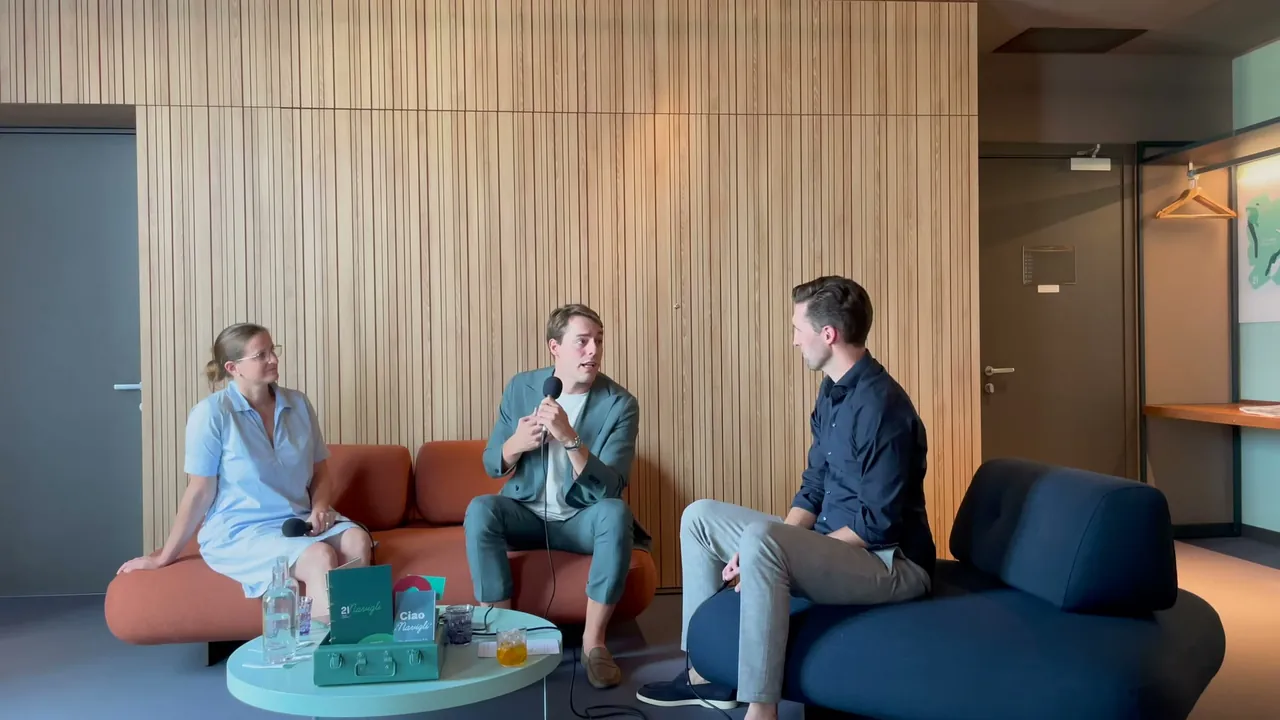
Aufgenommen: 21 House of Stories Navigli, Mailand
 Germany43 Min
Das Video kommt von YouTube und lädt erst, wenn du auf Abspielen klickst.
„It's an Italian product, and I always highlight that there are not really so many Italian brands that are expanding outside of our borders.“
Theo Bortoluzzi, 12:24
Theo Bortoluzzi zeigt Ronald M. Arndt und der neuen Co-Hostin Katharina Beatriz Varga das 21 House of Stories Navigli, das zweite Haus der Marke in Mailand. Er erklärt, warum Hotel, Bistro Domenica, Coworking und Events in jedem Haus zusammenkommen müssen, und wie aus einem leerstehenden Telekom-Bürogebäude 104 Zimmer mit Rooftop-Bar wurden. Dazu geht es um das Wachstum der Marke über Pacht- und Managementverträge in Italien, der DACH-Region, Frankreich, Spanien und Portugal.
Die Audiodatei kommt beim Abspielen von Spotify for Creators. Vorher wird nichts geladen.
Kernaussagen
- Vier Verticals als Pflicht: Jedes Haus braucht Hotel, das Bistro Domenica, Coworking und Events. Fehlt eine dieser vier Säulen, ist das Konzept für Theo nicht vollständig, deshalb kommen nur städtische Lagen mit Einheimischen in Frage.
- Betten verschwinden: Im Aufnahmeraum klappt das Bett nachts herunter, tagsüber dient er als Event- oder Meetingfläche. Der Zimmertyp Outlaw hat Lounge, Fitnessfläche und Schreibtisch unten, das Bett eine Treppe höher.
- Wachstum über Pacht: Die zwei Mailänder Häuser betreibt die Gruppe als Eigentümer. Für die Expansion setzt Theo auf Pacht- und Managementverträge mit Investoren und Entwicklern, Häuser von 70 bis 250 Zimmern in zentralen oder halbzentralen Lagen.
- Community mit eigenem Kalender: Ein Community Manager stellt einen Wochenkalender mit Konzerten, Streetmarkets und Talks auf. Studenten nutzen das Coworking gratis, Non-Profit-Vereine bekommen die Räume oft kostenlos.
- Zwei Umbauten: Città Studi war eine leerstehende Schule, Navigli ein halb abgerissenes Telekom-Bürogebäude. Nachbarn klopften schon vor der Eröffnung an, um zu sehen, was aus dem Haus wird.
Shownotes zur Episodeaus dem Podcast-Feed
Let’s open a new chapter and welcome Katharina Beatriz Varga as our new Co-Host of HOTEL-PODCAST.COM.
Furthermore, we teamed up with JUNG as our third official partner. Thank you very much!
Our first journey took us to the exciting city Milan. Theo Bortoluzzi introduced us to the surprising concept of 21 House of Stories.
After the founding vision of Alessandro and Mauro Benetton in 2020, the brand will now expand across Europe.
What makes the company so special and what does „Italian Ospitalità“ mean in the end?
You’re warmly welcome to tune in and watch our first podcast in Italy, we’ll definitely go there again. Have fun listening!
Keine Episode verpassen
Folge HOTEL-PODCAST dort, wo du sowieso hörst. Neue Episoden aus sechs Ländern kommen dann ganz von selbst. Oder tritt unserer WhatsApp-Community bei, um über alle Neuigkeiten auf dem Laufenden zu bleiben.
Weitere Episoden
Alle Episoden
Transkript
Transkript öffnenTranskript schließen43 Min · Ronald M. Arndt und Theo Bortoluzzi
Automatisch transkribiert mit AssemblyAI, Sprecher automatisch zugeordnet. Nicht redigiert.
- 00:00 Ronald M. Arndt
Buongiorno!
- 00:00 Theo Bortoluzzi
Buongiorno!
- 00:01 Ronald M. Arndt
Or ciao? What do you say?
- 00:03 Theo Bortoluzzi
We say weilà in Milan. Weilà?
- 00:08 Ronald M. Arndt
Never heard.
- 00:08 Theo Bortoluzzi
Yes, yes, yes. It's a way of saying hello in Milan, and it's a very typical, let's say, regional way of saying it.
- 00:16 Ronald M. Arndt
Nice. Interesting.
- 00:17 Katharina Beatriz Varga
And it's what it says on the room cards.
- 00:19 Theo Bortoluzzi
Exactly.
- 00:20 Ronald M. Arndt
Exactly.
- 00:21 Theo Bortoluzzi
That's why we put it there. Yes, yes, yes.
- 00:23 Ronald M. Arndt
Good eye.
- 00:23 Theo Bortoluzzi
Good eye, Tenzin.
- 00:27 Ronald M. Arndt
A lot of first times today for us. I think the first time also for Katharina as co-host here in the Hotel Podcast.
- 00:36 Katharina Beatriz Varga
Yes, I'm excited.
- 00:36 Ronald M. Arndt
Welcome.
- 00:37 Katharina Beatriz Varga
Thank you.
- 00:38 Ronald M. Arndt
Katharina from Jung, our new official partner on the Hotel Podcast. The first time for the Hotel Podcast in Italy as well. And of course, the first time for you, Theo.
- 00:50 Theo Bortoluzzi
Super. Let's make it a great one.
- 00:53 Ronald M. Arndt
Yeah, it's the first time in the podcast in general, or?
- 00:56 Theo Bortoluzzi
First time on podcast, yes. I've been to some of the events, hospitality-focused events. I've tried to speak on stage sometimes. It went well, but at podcast, yes, it's the first time.
- 01:10 Ronald M. Arndt
Yeah. And where do we are here?
- 01:12 Theo Bortoluzzi
Well, we are at 21 House of Stories, Navigli, and it's our second location here in Milan. We're, of course, a hotel company. And I hope you're enjoying it. We were able to look a little bit at some areas. I hope you enjoyed it.
- 01:28 Katharina Beatriz Varga
Yeah, we had a tour around the house. Thank you so much. Before starting recording the podcast. And we actually really were impressed by the building because you have so many different concepts in here. So maybe you can tell us about the different concepts.
- 01:44 Ronald M. Arndt
Very flexible here. So there's even no bed here in the room.
- 01:47 Theo Bortoluzzi
Yes, we are in a room. So yes, to go even more to the point of your question, we are in a room and there's no bed at the moment. But surprise, surprise, the bed will come up at night because we have some very special rollaway beds that can go down and can also allow to use a room for a different purpose. So whether it is a podcast or whether it is a private event, a small cocktail from either a birthday celebration or a company that wants to invite some of his colleagues. So that gives us really that flexibility to use the spaces a little bit Great.
- 02:23 Katharina Beatriz Varga
I had a very nice and funny experience, like also a surprising bed experience when I checked in. I actually work a lot with hotel concepts and I sleep a lot in hotels, so business-wise. And I came into the room and there was no bed and actually didn't even find it. And I had to ask you where the bed is. And the room, you said it's a special room. It's a room type. You only have like 10 room types, the one I'm sleeping in?
- 02:52 Theo Bortoluzzi
Exactly. It's called Outlaw. And in that case, the room is a little bit different than this one where we're staying right now. So you basically have— it's a lofted room. So you have the, let's say, the ground floor, the base floor where you have a lounge area, a space for fitness. So if you want to train, want to do some exercise, you have enough space. You don't have the bed in the middle, which of course takes out some space. You have also a desk where you can work. where you can do your coworking and your calls. And then the bed, there's some stairs that brings you upstairs and there's a bed, which of course gave us the opportunity to really play a little bit with space. And yeah, it happens sometimes, people looking at the bed and they need to look up to look at the bed.
- 03:32 Ronald M. Arndt
Yeah.
- 03:32 Katharina Beatriz Varga
And the stairs, they actually look like a shelf. So if you don't look around the whole room and once you enter to the hallway from the elevator, it just looks like a common hallway, so you would not think that there's like a 2-floor room in there.
- 03:46 Theo Bortoluzzi
Yes, it's a surprise.
- 03:47 Katharina Beatriz Varga
Yeah, it is.
- 03:48 Theo Bortoluzzi
We try to make it a surprise.
- 03:50 Ronald M. Arndt
So again, very flexible. But in general, I think Italians are quite flexible.
- 03:54 Theo Bortoluzzi
Yes, I would say we're quite flexible. We're very traditional with regards to food. So over there, we can be a little bit less flexible. I mean, if you bring a carbonara with the bacon instead of guanciale, then they start looking at you a little bit weirdly.
- 04:12 Katharina Beatriz Varga
Flexible culture, but non-flexible food.
- 04:15 Theo Bortoluzzi
Exactly. Exactly.
- 04:17 Ronald M. Arndt
So you said, Theo, it's the first— not the first, the second location in Milano for the brand.
- 04:23 Theo Bortoluzzi
Correct. Exactly. So the group started in 2020 with the opening of the first location in our neighborhood, which is called Città Studi. It's a very residential neighborhood in Milan. And well, yeah, funnily enough, we opened in February of 2020. Well, many people might remember what happened in March. So of course, that was, let's call it a problem at the first time. But then actually, it helped us a lot because we were able really to align all our systems and our processes during that time. And well, of course, when the restrictions went down, we started in full, and it was a very successful opening. So now in Città Studi, we're operating since 3 years and a half, and it has been a really, really good journey so far. So excited about what's next. Of course, the successful opening of Città Studi then led us to Navigli, which is where we're sitting today, where we're staying. And this is also the evolution of the concept. It has differences because we don't like to repeat and just to work on cookie cutters because that's kind of boring nowadays. So especially when you talk lifestyle hospitality, you always try to find some nice touches on each building that really bring a story alive. And that's what we try to do here in Navilli.
- 05:49 Katharina Beatriz Varga
And we're in the fancy part of Milan, right?
- 05:53 Theo Bortoluzzi
We are in the fancy part of Milan. So Navilli—
- 05:55 Katharina Beatriz Varga
The new fancy part.
- 05:56 Theo Bortoluzzi
It's a trendy area for sure. So Navigli is well known for bars, restaurants. People go out. There are some nice canals down here. You can actually see them from your room and from the terraces. So it's a really popular area of Milan where people like to go out, spend some time with friends. And well, I think that we embody perfectly the mood of the neighborhood. So that's this lifestyle, lively atmosphere. It's something that really matches well with the location.
- 06:29 Katharina Beatriz Varga
So when you showed us around, Theo, it was really special, the social aspects you work with. And you actually really live the community and also have a very integrating community here. Concept in the lobby is like with the students and how's— what idea is that?
- 06:54 Theo Bortoluzzi
So, well, let's start from the base of the concept, which is taking hybrid hospitality. So hybrid hospitality, of course, is something that was far more developed in Northern Europe, but in Italy was something and it's still something very new. So there are many little players, very little players in this segment.
- 07:15 Katharina Beatriz Varga
Although the Italians are so social and so flexible.
- 07:17 Theo Bortoluzzi
Although the Italians are so social and flexible, exactly. So, well, hybrid hospitality, first of all, something absolutely new in the Italian hospitality market. And the way we do it is looking at 4 verticals. So we have, of course, the hotel piece, which is the big piece. We are a hotel at the end of the day. So you have the rooms, but then we have the F&B. So we have our own bistro experience, which is called Domenica, which means Sunday, of course, in Italian. And it tries to recall the concept of the Italian Sunday where people stay at home with their families and have their lunch. Of course, people come here with friends, even colleagues, work colleagues, they come. But the idea is really conviviality. So people share the dishes. It's a very nice and pleasant atmosphere, not the, let's say, strict and business type of experience that you would expect in other areas. So this is the F&B part. Of course, then depending on the location, we add bars or rooftop bars. So here in Navigli, we're lucky enough to have a beautiful rooftop with a pool and with a nice bar. During the day, it's used by hotel clients, so they come and they spend the day at the pool. But then at evening, starting from 7 PM, we have a lot of locals that come in and enjoy a really nice aperitivo with the sky view of Milan and That's really, really nice.
- 08:44 Katharina Beatriz Varga
And the bar is Mirador, right?
- 08:45 Theo Bortoluzzi
The bar is called Mirador. Exactly.
- 08:47 Katharina Beatriz Varga
And is that an external operator?
- 08:50 Theo Bortoluzzi
No, it's your own. Yes, we do everything in the building. So we operate all the verticals because adding to the hotel and to the F&B, we have 2 more areas that we work with. Coworking, which you saw at the entrance. So we have an area which is dedicated for coworkers, people that come They spend the day working here or studying. And we have different formulas. So we have students that come and we have some bonuses with the universities. So if you're a student studying in Milan, you can come and use our space for free. On the other hand, if you are freelancers, there's a daily package which is really accessible, but you can use our spaces. You have some refreshments as well, water, coffee, of course. Course, you can never miss coffee in Italy. And well, people come work and they really create stories. And that's also at the base of our name, right? So we have people that come work, but they share stories, they try to engage. There are startuppers that come and they share ideas and maybe new ideas come up on the way. So that's really the type type of space that we try to create and to live also ourselves, because all of us working at 21 House of Stories, especially the central services team, so we work from the coworking areas. So forget about the classic office, standard office. We like to share the space and live the areas ourselves as well.
- 10:25 Katharina Beatriz Varga
Ronald, we should go back to studying in Milan.
- 10:29 Ronald M. Arndt
Yeah, just thinking about it.
- 10:30 Theo Bortoluzzi
Well, yes, yes, it's a good option. Well, going back to time.
- 10:36 Ronald M. Arndt
So I fully understand the second part of the brand name, Home of Stories, but do you know where the 21 comes from?
- 10:42 Katharina Beatriz Varga
Of course.
- 10:42 Ronald M. Arndt
Well, how long are you now in the company?
- 10:46 Theo Bortoluzzi
Well, yes, I'm quite new in the company, but I've done my—
- 10:49 Katharina Beatriz Varga
Fresh and flexible.
- 10:50 Theo Bortoluzzi
Fresh and flexible, but I try to do my homework well, so Well, of course, House of Stories, by now you have understood where it comes from. 21, I will very shortly brief you the story around it. So the idea and the brand, the group was founded by Alessandro and Mauro Benetton. They come from a really, really, let's say, great entrepreneurial family in Italy, which I'm sure you have heard of.
- 11:21 Ronald M. Arndt
Even Germans know them.
- 11:22 Theo Bortoluzzi
Of course.
- 11:23 Ronald M. Arndt
From Formula 1.
- 11:24 Theo Bortoluzzi
Ah, yes, as well.
- 11:25 Ronald M. Arndt
My childhood.
- 11:26 Theo Bortoluzzi
And well, so the idea came from them. And 21 is a very common name, especially from Alessandro, because back in the days he created a private equity firm which is called 21 Invest. And 21 means the 21st century, basically. So we are— the design that we have is actually contemporary. So that's also a little bit the philosophy that follows the brand. So that's at the base of the name.
- 11:54 Ronald M. Arndt
Our German audience might know Stuttgart, Stoccarda 21. It's a very big project as well.
- 12:02 Katharina Beatriz Varga
Okay, never-ending story.
- 12:04 Ronald M. Arndt
It's a never-ending story.
- 12:06 Theo Bortoluzzi
Well, we hope ours as well will be a never-ending story, but on the positive side. Yeah, another first.
- 12:19 Ronald M. Arndt
You want to expand, of course. Yeah, imagine.
- 12:21 Theo Bortoluzzi
Yes, yes, absolutely.
- 12:22 Ronald M. Arndt
When you have 21 locations.
- 12:24 Theo Bortoluzzi
Yes. No, and we hope we can go even further. So the sky is the limit. But really, because the concept that we have here, and this is the reason we were saying I joined recently. Yes, I've been— I joined the group in May, and since the first time that the team contacted me, I didn't have any doubt about it because the product is there. Because you have seen it. I mean, it's a really nice hotel. It's really different. It's surprising because you have rooms that don't have a bed, and then you find the bed upstairs in the lofted part. You have rooms with disappearing beds that can be transformed into meeting areas or event spaces. And then you have the coworking, the event piece, which is also a very big area in our story. So it's a really nice product. It's an Italian product, and I always highlight that there are not really so many Italian brands that are expanding outside of our borders. You hear a lot of German, Dutch, British, American brands in the hotel industry that expand internationally and globally.
- 13:30 Katharina Beatriz Varga
Especially the approaches you do.
- 13:33 Theo Bortoluzzi
Yeah, exactly. And well, especially even in the hybrid context, it's very limited, the supply of products. So I think that there is a great opportunity here. And behind all of these, again, the story that the group is trying to really share is also with the event piece. So I didn't mention, but the 4th vertical after hotel, F&B, coworking is events. And we do a lot of events. We do events for private companies that rent the spaces and they do their normal corporate events. Not normal because the spaces are different. So instead of being in the classic, let's say boring, without no one hearing us meeting room, you have a, well, a surprising space which can be either a room or it can be a terrace. So it's something really nice and different and people really appreciate it, especially business and corporations. And then you have the entire community piece. So this is our way of giving back to the local community because we have one community manager that actually organizes a weekly calendar of events. And those events are targeting the locals. So they're targeting people living around the area, people living in Milan. And those events can vary from concerts or music events where we bring artists Especially local artists again. So we give them the stage, we give them the opportunity to actually be in front of the public, even an international public. We bring in other cases, we bring and organize kind of street markets where people come and they have also the opportunity to share clothes and create a nice experience. We have organized that in the courtyard that we have next to the entrance.
- 15:29 Katharina Beatriz Varga
Always involving the neighborhood, right?
- 15:31 Theo Bortoluzzi
Absolutely, 100%. And then finally, we also have events that we organize with local associations, even nonprofit associations. In that case, we give them our spaces. And when I say we give, it's actually many times we give them the spaces for free because they can come, they can use the spaces, they can share a valuable story which has a really strong social impact. And we can actually give them the opportunity to have a home, a house where they can organize their event, where they can bring their people. And that creates a really unique story because we have a lot of Milanese people that come here, they discover 21 House of Stories. And many times, of course, they're surprised because they see something totally different from what they were used to. And well, this is a really nice way, I think, to give something back to the community where you're staying. So that's a really nice social angle that we try to contribute in the areas where we operate.
- 16:30 Ronald M. Arndt
Yeah, Katarina, we discussed this morning that we don't know that many Italian brands that are expanding to the DACH region, for example.
- 16:41 Katharina Beatriz Varga
And it's actually nice that there is one.
- 16:43 Ronald M. Arndt
Yeah, it's nice that we found one. Sure, that you found one. Yes, honestly, they found us, but we found each other. We were looking for—
- 16:52 Theo Bortoluzzi
yes. And although I'm sure, I mean, Italians are always made fun of, but we are also— people like Italian design. And in general, the style, the decoration, the F&B. So if you're having a restaurant, we have it really Italian and it's authentic. So I'm sure that especially in the DACH region, but in other European countries, there is a great opportunity to come in and show a little bit our We call it hybrid ospitalità, which is of course the translation of hospitality, but it tried to really show that we have that Italian touch within our values.
- 17:32 Katharina Beatriz Varga
I think that not only people also like Italian design, it's an example. And according to design, Italy and like Scandinavia, for instance, are a good example for good design.
- 17:47 Ronald M. Arndt
Of course.
- 17:47 Katharina Beatriz Varga
It doesn't matter what— clothes, food, furniture, whatever.
- 17:51 Ronald M. Arndt
Drinks, everything together.
- 17:53 Katharina Beatriz Varga
Everything is beautiful.
- 17:55 Theo Bortoluzzi
Yes. And at the end of the day, it's a lifestyle. And that's what we try to create here. So going from food to design to anything, you can create that Italian lifestyle that people are looking for always.
- 18:07 Ronald M. Arndt
Do you have a specific market that you want to go into?
- 18:10 Theo Bortoluzzi
Well, in our plan now that I joined, of course, in May, as I was saying, and the plan for me to join was, of course, to start growing the brand. So the team over the past 4 years now, they have done an incredible job in building, bringing to life these 2 locations that we have here in Milan that are our operating hotels at the moment. And I am sure that now the brand, the product is ready and it's ready to expand in different markets. Of course, we are looking to expand in Italy. So there are many cities or locations where we could actually open at 21 House of Stories, but we're not limiting our view only in Italy. We're definitely looking to come also in other countries. The DACH region, absolutely interesting. France, Spain, Portugal, they all are really interesting locations for us to bring our brand because we saw that there is a lack of this product. We can bring something new that probably is not present there. So we actually, since we started this journey of development, we saw interest. So we hopefully will be able to bring down some good hotels in our pipeline.
- 19:31 Ronald M. Arndt
Do you know if the Benetton brothers or family have any experience in hospitality or in operating hotels?
- 19:39 Theo Bortoluzzi
No. Well, this was actually their first project. Yes, it's the first project. And But I have to say that it has a promising future because it's really down to the detail. It's trying to touch all the important aspects of hospitality and not focusing only on the classic room and breakfast, right? Trying to bring something new, innovative, and that's going to be, let's say, an important factor, especially when you go outside.
- 20:14 Ronald M. Arndt
Right.
- 20:14 Katharina Beatriz Varga
I think the first interesting factor you bring already is that you're an Italian brand. That's so fresh and new. You know, it's— I think, I think, yeah, the people will be interested in listening to your concept and looking at the concept just because you're different of— there's a difference to the countries you know these concepts from, right?
- 20:33 Theo Bortoluzzi
Yes, yes, absolutely. And that's also the feedback that we start hearing now that we talk with—
- 20:39 Katharina Beatriz Varga
You do already?
- 20:40 Theo Bortoluzzi
Yes, yes, yes. We have started, of course, some discussions with people overseas in different countries, and they are surprised about having a hybrid hospitality brand coming from Italy. And on top of that, they are surprised about the type of offer that we're able to bring on the table because it's new and it's something that people will enjoy to discover. So we're always welcoming everyone that we talk to to visit us in Milan and really live the experience. Because yes, you can see it from pictures, you can see it from our social medias that are really active, but when you come here and you live it, it's like walking the talk. Because I hear a lot of people talking about the community, about the events, etc., etc., and many times it's just many talks and little facts. When I came here, and also part of the decision of me joining the brand is that Really what we try to communicate is happening on site. So this entire piece of the community shared value, so trying to give back something to the community, to the locals, is really, really happening. And it's extremely interesting for me. So you come here and you see different types of events, whether it is painting ceramics, whether it is a live music concert, a street market, as I was saying, a talk from, let's say, some influential people that come and maybe share their stories. It's something really nice. And travelers like it. They like to be in this type of environment and locals like it. Yeah.
- 22:23 Ronald M. Arndt
You showed us the building earlier. How many rooms do you have here?
- 22:26 Theo Bortoluzzi
So here in Navigli, we have 104 rooms. Plus the surprises? With the surprises, with the surprises. Yes. And then we have the restaurant on the ground floor, Domenica. We have a bar, cocktail bar on the ground floor. We have a lot of event spaces. We have secret terraces. There are even areas that I still need to discover. It's a constant surprise. And then, of course, you have the rooftops, which have been booming since we opened because here we opened just in September of last year, 2023. And since we opened, the need for the people to discover the rooftop was immense. So people, especially locals, they were coming and it has been a really great success, Mirador. So now we have a reservation system in place. So people People need to reserve to have a really nice experience, and they can come to really have, we can say, some of the best aperitivos in Milan.
- 23:31 Katharina Beatriz Varga
How come the bar name is Spanish and not Italian?
- 23:35 Theo Bortoluzzi
That's a good question. I think it's mainly because we wanted to create that Mediterranean vibe, and I think that when creating the brand, The idea of having also another Mediterranean concept in mind was nice. And if you see the rooftop, it's really— there is that type of Mediterranean vibe in it.
- 24:01 Katharina Beatriz Varga
Yeah, absolutely.
- 24:02 Theo Bortoluzzi
So you can actually feel it and live it. And we're not obsessed Italians, so of course we're—
- 24:08 Katharina Beatriz Varga
Otherwise you couldn't expand.
- 24:10 Theo Bortoluzzi
Yes, exactly, exactly. We're totally, of course, open and aware that Whenever we will also enter in different markets, we will always look at local trends, what the locals are looking for, because of course if we open in, let's say, Berlin, we will look for the locals to come to our community spaces. There will probably not be so many Italians.
- 24:34 Ronald M. Arndt
So we need to be open and of course create a place that shares good values for Talking a little bit about your work, do you think it will be easy to find new locations? Or here we're talking about a building that has been converted, or is it new?
- 24:57 Theo Bortoluzzi
Yes, so that's actually a really nice question because both our locations, the one in Città Studi and the one in Navigli here, so they were They are conversions. They formerly were, in case of Città Studi, it was a school, abandoned school. And in the case of Navigli here where we're staying now, it was an abandoned telecom building. It was an office. And when you see the pictures, and I will show you later, of how the buildings were before, they were horrible. They were super poorly maintained, half demolished. So it was really also— Pretty bad experience for the neighborhood in general, for people that were walking around to see this ugly building, let's say, laying on the street. And well, what our group, our founders, our shareholders wanted to do is really to have this urban regeneration. So when they purchased these buildings, they started reconverting them. The entire facade was, well, it was polished and it was put in good shape. And now even the locals, before we were opening, they were coming to our door knocking and asking to see what was going around because they were surprised. They always saw that ugly building with no purpose in such a nice and trendy area. And they finally saw it differently with a nice design, with a nice concept behind. So it was really a nice urban regeneration process. And honestly, I think that also looking at the future projects, there are many types of locations like these in Europe, in urban cities, where you can take offices or buildings coming from different uses and convert them into a nice mixed-use hotel concept.
- 26:52 Katharina Beatriz Varga
Will the owner-operator concept Will it last?
- 26:57 Theo Bortoluzzi
No. So the first 2 locations here in Milan, they were an owner-operator, let's say, context, because of course we were starting from zero. We wanted to really perfection the brand and put it to the detail as we wanted. Now, looking at expansion, the plan is to expand through mainly leases and management agreements. So we are looking, of course, to partner up with other real estate investors, developers that own buildings and would like to create a nice story with us. So that's the type of expansion that we're planning now. Of course, we're looking at urban cities. So we are not really at this stage a leisure destination. And when I say leisure, I say either a beachside or a mountain.
- 27:49 Ronald M. Arndt
Yeah.
- 27:49 Theo Bortoluzzi
type of resort. We're more of an urban— we need that urban context because otherwise we wouldn't have the locals. And as I said many times, because I think I'm repeating the word a lot of times, it's extremely important for us to have those 4 verticals, not only the hotel, not only the F&B, but the coworking and the events. And those 2 last pieces, you need a city for bringing them to life.
- 28:13 Katharina Beatriz Varga
Yeah, that's true.
- 28:14 Theo Bortoluzzi
Yes, we don't need only capitals, so we're not looking to expand only in, let's say, A cities. Of course, to enter a new market, we would like to be in a good location and in a good city. But any city that has a good cultural context behind, with a good number of visitors, yearly visitors, could be a good destination for us.
- 28:39 Katharina Beatriz Varga
I actually have a totally different question. Or would you like— you had a question concerning What he just said? Ladies first.
- 28:48 Ronald M. Arndt
Okay. It's new for me, I know, but—
- 28:51 Katharina Beatriz Varga
You have to get used to that, my dear. What about the monkeys?
- 28:55 Ronald M. Arndt
Which monkeys?
- 28:56 Theo Bortoluzzi
Okay, which monkeys? Now we need to tell the story because otherwise the—
- 29:00 Katharina Beatriz Varga
The wallpaper.
- 29:01 Ronald M. Arndt
Yes. It's so nice visiting a new hotel with you, with a female view. Yeah, I didn't check the cards. I don't know what's written on it.
- 29:11 Theo Bortoluzzi
Did you see the monkeys?
- 29:12 Ronald M. Arndt
I didn't see any monkeys.
- 29:13 Theo Bortoluzzi
No, we don't have a live monkey. things going on in our hotel. But well, we like to create always lively spaces with a nice design. And well, the idea specifically here in Navigli was to have some wallpapers, especially in the common areas. And some of the, let's say, common figures appearing were monkeys. So that's where they're coming from. But honestly, it's just a a design touch to make the area cozy, to give it a nice design. And people appreciate it because it's fun, it's alive, and that's the type of vibe that we would like to create.
- 29:53 Katharina Beatriz Varga
Spreading some joy.
- 29:53 Theo Bortoluzzi
Exactly. So we're a fun concept, we're a lively concept. We're not a boxed, as I said before, cookie cutter with gray walls and boring furniture. So that was the idea behind it.
- 30:09 Ronald M. Arndt
This question I always like in the Hotel Podcast. So to know when and why someone started working in hospitality.
- 30:18 Theo Bortoluzzi
Oh, that's a good question. Yes. Well, why did I decide to work in the hospitality industry? The first question would be, why did I join this industry? Because I actually studied hospitality. So right after high school, I went to university. And I went to Les Roches. Les Roches is a, well, it's a well-known hospitality university with the main head campus in Switzerland. And they have actually 2 campuses, one in Marbella and one in Shanghai. Guess where I decided to go? I went to Marbella. It was, of course, a great experience, but I really started knowing about the hospitality industry over there. And it was a really nice experience back at university because since we started, they pretty much gave us an eye on all the parts of the hospitality business, starting from operations. So you would start from being a waiter, being, well, an housekeeper or a cook. So trying to get a little bit of the experience, the practical experience. Yeah. And then of course, moving into the business side of it, which is hospitality management and anything that goes around it, finance, sales and marketing and all the other departments. Because of university, we were required to have 2 internships. I did my first one in Hong Kong working for a very big hotel chain, which is Marriott. And then I did my second one with an Irish group, which is called Curtin Hospitality. And I joined doing business development, which was an area that always interested me because I'm very interested about investments in general. And well, of course, business development is a little bit the bridge between investments in real estate and the hospitality industry. So it got me really interested. I had an amazing experience over 4 years and a half with them. I learned a lot from great leaders. And, well, earlier this year, I got the opportunity to start a new journey with 21 House of Stories. And I took it immediately because I really saw the great potential that was around it. Yeah.
- 32:46 Katharina Beatriz Varga
But you came from Barcelona, right? To Milan?
- 32:49 Ronald M. Arndt
Yes.
- 32:50 Theo Bortoluzzi
So I've been living during the past 7 years in Spain from university and then continuing with my work. And I was, yes, between Marbella and Barcelona, and now I'm back. So I'm back to Italy, which of course is my home country, and very happy for it and looking forward, of course, to continuing this journey.
- 33:15 Katharina Beatriz Varga
And we're very happy from Hotel-Podcast to be part of The journey starting.
- 33:21 Theo Bortoluzzi
Yes, yes. I'm happy to be here with you because, of course, it's the real beginning. And hopefully we will have another podcast maybe in a year or even more. And we will have some exciting news with new projects to share with you.
- 33:36 Ronald M. Arndt
Yeah.
- 33:36 Theo Bortoluzzi
So this is the start of the journey.
- 33:38 Ronald M. Arndt
Of course.
- 33:38 Theo Bortoluzzi
Hopefully a very successful one.
- 33:40 Ronald M. Arndt
In Germany, Austria, Switzerland, we're also doing, always doing yearly updates. So this will be 2024.
- 33:46 Theo Bortoluzzi
Okay, super.
- 33:47 Ronald M. Arndt
Let's see again next year. But you're from the northern part of Italy, or where do you come from originally?
- 33:55 Theo Bortoluzzi
Yes, I was born in a very small town in Veneto, which is the region where Venice is. Probably everyone knows it for that. I grew up in Rome with my mom. And so I've always been in between Rome and the northern part of Italy. And then from Rome, where I ended my high school, let's say, journey, I went to Spain directly.
- 34:21 Katharina Beatriz Varga
Yes.
- 34:21 Ronald M. Arndt
But your mom sent you to the hospitality school, or when did you take this decision?
- 34:25 Theo Bortoluzzi
When did I get this inspiration?
- 34:26 Ronald M. Arndt
That's always good.
- 34:27 Theo Bortoluzzi
To be honest, it's very difficult to explain. I think it just came almost automatically. I did have some friends going to this university. So of course, when I looked on the website, I would say I was Okay, that looks interesting.
- 34:46 Ronald M. Arndt
Nice pictures.
- 34:46 Theo Bortoluzzi
Nice pictures. Especially when I was— Price flexible.
- 34:51 Ronald M. Arndt
Yes. Switzerland or Spain.
- 34:53 Theo Bortoluzzi
Marbella, yes. Especially when I looked at Marbella, I was quite— my eyes got bright. Yes, exactly. And then even when I was at high school, very randomly, I had during summers, I was working because we had very long summers. Of holidays. So of course, I tried to do something with my life over those periods. And I was doing some small works for some months. And I ended up working in a hotel in Barcelona for 3 months. And I really got interested in the fact that there were so many businesses within one building. So you had the food and beverage, the hotel side of it. But then on the back, you had the entire back of house with reservations, sales and marketing, finance, And I think I got really interested in that part of the business. And then on top of it, I mean, and something that also we learned from our university is that what's hospitality? Where hospitality is a business of putting smiles on people's faces, right? Because when you come to a restaurant or you come to a hotel, you always try to give a good experience. And I really like that. So that was at the base of my interaction with hospitality. And then, of course, little by little, studying, working, I really got specific and I got a real great interest into investments, real estate. So I moved to the business development side of it.
- 36:20 Katharina Beatriz Varga
Do you have any siblings, like brothers and sisters?
- 36:24 Theo Bortoluzzi
No, no, I'm an only child.
- 36:26 Katharina Beatriz Varga
Yes. It's actually astonishing that you—
- 36:30 Ronald M. Arndt
I think he felt alone.
- 36:31 Katharina Beatriz Varga
You know what I mean?
- 36:34 Theo Bortoluzzi
You needed more people around you without any Well, yes, I've generally been social, so I've always liked to be around people.
- 36:41 Katharina Beatriz Varga
Are you Italian?
- 36:42 Theo Bortoluzzi
Yes, I'm Italian, so we are— we have this Mediterranean blood, of course. But yes, hospitality comes really easy, let's say.
- 36:52 Ronald M. Arndt
Now you're expanding to Europe with the brand, you're looking for new locations, buildings. Are there any minimum requirements you need, or? Well, because we also, the audience knows that people—
- 37:06 Theo Bortoluzzi
Yes, if you do have some locations for us, we're very happy to look at it.
- 37:11 Ronald M. Arndt
Tell us a little bit about it.
- 37:12 Theo Bortoluzzi
So what we're looking is buildings in central or semi-central locations. So again, we don't want to be in the peripheral area of a city because probably we wouldn't be the best operator to bring to life that area, but to be even just being in a semi-central location, we could create some great stories. And the example of Città Studi, so our first location, is perfect. So it's a residential area and we were really able to create something new. So location, first of all. Second of all is spaces. Of course, if you want to create all of this, you need a minimum size. We wouldn't look at boutique hotels of 20 rooms, 30 rooms. We would generally look at something from 70 rooms up to 250. Of course, we are somehow flexible on that as well, depending on the location. So we're not stuck on our rules, but what we must have in all our buildings is the 4 verticals. So we must have the hotel side, we must have the restaurant with our Domenica Bistro, we shall have the coworking and the event piece, because that's really the essence of the brand. If we have one of those 4 verticals missing, then It's like we would be missing something.
- 38:28 Katharina Beatriz Varga
It's not fulfilled.
- 38:29 Theo Bortoluzzi
Exactly. So that's the real need, and that's pretty much what we're looking at.
- 38:36 Ronald M. Arndt
Where does a nice design come from? You're working with an interior design company, or is it more Benetton style?
- 38:45 Theo Bortoluzzi
No, no, no. So in this case, well, we work with interior designers, and we normally, depending on the location, we would work with different ones. So we're of course We are of course open to new collaborations, and we always look for the greatest idea. So whenever we will have a project, as let's say normal processes, we will have a tender, and we will try to get the best idea from the designers as well, so that we can create a nice story, a nice building, and something new.
- 39:17 Katharina Beatriz Varga
But do you also have your own designers at 21 House of Stories?
- 39:21 Theo Bortoluzzi
No. So we like to collaborate with external companies this case. Of course, we have a technical team behind that supports during the journey, so we will just not give a whiteboard. But there are some, let's say, parameters that we have set, and this is an exercise that we have done also recently because of course there are some specific brand items that we would like to repeat.
- 39:47 Katharina Beatriz Varga
Yeah, of course.
- 39:48 Theo Bortoluzzi
Just here we have our story box, and it's one of the boxes that we have in all our rooms. And it's really a little bit a box containing a lot of stories. So you have everything you need during your journey. And it's a nice way of putting it together, right? So it's not the classic traditional style of amenities that you would find in a hotel room.
- 40:12 Ronald M. Arndt
Nice. So it's amazing.
- 40:16 Theo Bortoluzzi
Yeah, it's amazing.
- 40:18 Ronald M. Arndt
It's also for us to join this story now. So very happy at this stage.
- 40:25 Theo Bortoluzzi
Yes, very happy to have you at this stage of our growth. And as I said, it's of course, it's a growing story. It's a growing company. And I'm sure we will have a lot of opportunities to share updates and show you a little bit what news do we have.
- 40:43 Ronald M. Arndt
And don't forget to show me where I will find the bed.
- 40:47 Theo Bortoluzzi
Yes, yes, we will be.
- 40:48 Ronald M. Arndt
If not, I'll stay on the rooftop tonight. We will show you yours.
- 40:51 Theo Bortoluzzi
Yes, yes, yes, yes. There will be a bed, no problem.
- 40:55 Ronald M. Arndt
Cool. So we're looking forward to our dinner that we have together.
- 40:59 Katharina Beatriz Varga
Our wonderful Italian dinner.
- 41:02 Theo Bortoluzzi
Yes, of course.
- 41:02 Ronald M. Arndt
Not flexible? No, no.
- 41:05 Theo Bortoluzzi
Well, there's a sharing piece of it, but yeah, it's a nice authentic Italian restaurant.
- 41:11 Katharina Beatriz Varga
Talking about food, actually, there is one last question. We were looking at the lobby.
- 41:15 Theo Bortoluzzi
Okay.
- 41:16 Katharina Beatriz Varga
There's the restaurant, right?
- 41:17 Ronald M. Arndt
Yes.
- 41:18 Katharina Beatriz Varga
It was 4:15 in the afternoon. Yeah. And somebody was having food. Do you serve food 24/7? Are there opening hours or?
- 41:27 Theo Bortoluzzi
Well, actually, well, our kitchen is open. We have mealtimes, of course. So there's a time where people are having breakfast and you will have breakfast tomorrow morning. So you'll let me know how the experience goes. I hope well. And then you have lunch and dinner. But generally during the day we have an open kitchen.
- 41:46 Ronald M. Arndt
So if—
- 41:47 Katharina Beatriz Varga
Whenever someone comes and is hungry, can have food.
- 41:49 Theo Bortoluzzi
Yes, exactly.
- 41:50 Katharina Beatriz Varga
There's no siesta.
- 41:50 Theo Bortoluzzi
Yes, exactly. Well, and we can accommodate. Of course, there are people coming and we have a lot of Germans coming because, well, Milan is a very popular destination for Germans. And I can say that they're one of our top, let's say, international guests. by demographic. And of course, there are people and there are certain countries that eat at different times. So you shall be flexible on that.
- 42:16 Ronald M. Arndt
Yeah.
- 42:16 Katharina Beatriz Varga
That's good. I like it.
- 42:18 Ronald M. Arndt
Again, very flexible, huh?
- 42:21 Katharina Beatriz Varga
Wonderful.
- 42:22 Ronald M. Arndt
Yeah. Wonderful. Thanks a lot.
- 42:23 Katharina Beatriz Varga
Talk to you soon.
- 42:25 Theo Bortoluzzi
Thank you.
- 42:26 Ronald M. Arndt
All the best for your future and see you next year.
- 42:28 Theo Bortoluzzi
See you next year.
- 42:30 Ronald M. Arndt
Bye. Ciao. Bye-bye.