Malin Widmarc-Nilsson & Thomas T. Hagemann, MEININGER Hotels
Hotel: MEININGER Hotels, Berlin
 Germany61 Min
Das Video kommt von YouTube und lädt erst, wenn du auf Abspielen klickst.
„The normal hotels, I say normal, would have the business traveler as a base business. We have groups as a base business.“
Malin Widmarc-Nilsson & Thomas T. Hagemann, 16:38
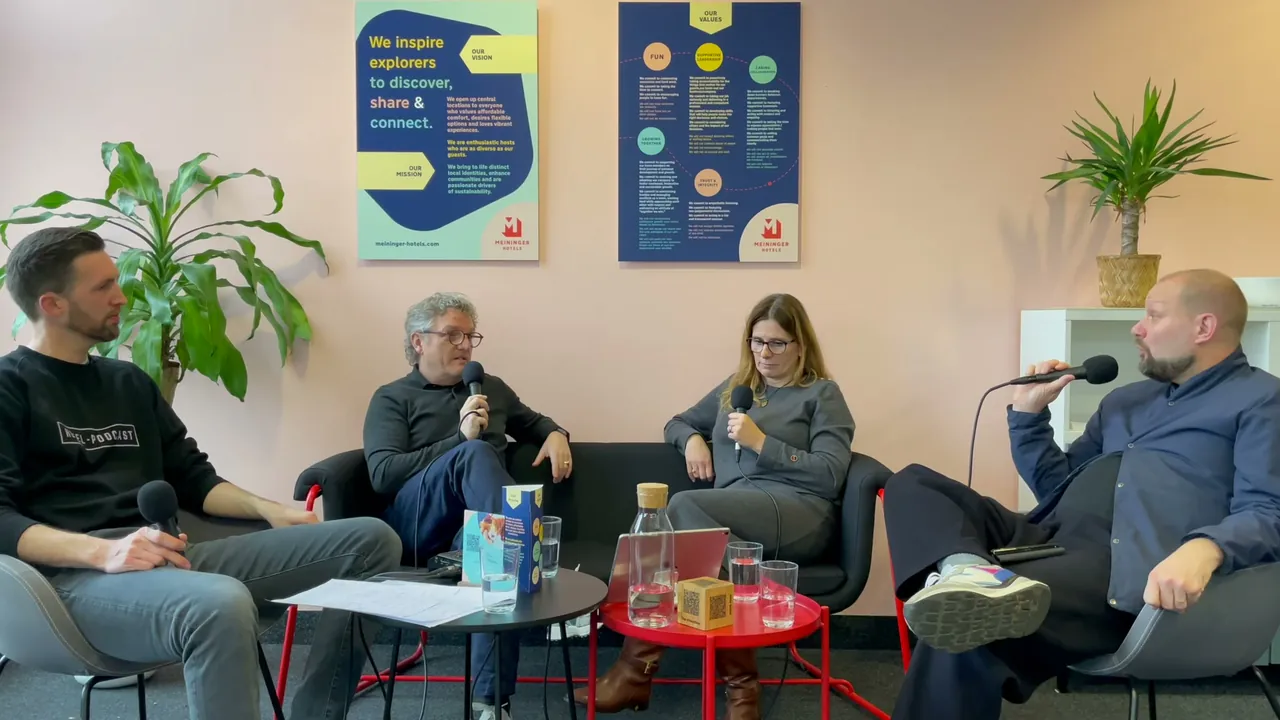
Malin Widmarc-Nilsson und Thomas T. Hagemann von MEININGER Hotels sprechen mit Ronald M. Arndt und Co-Host Joern Siebke über 25 Jahre der Marke, die 1999 in der Berliner Meininger Straße begann. Gruppen sind das Basisgeschäft, ein typisches Haus hat rund 50 Prozent Mehrbettzimmer mit vier bis sechs Betten, und 85 Prozent des Umsatzes kommen aus dem Zimmer. Dazu geht es um Gästeküche und Game Zone, Automaten mit Wundermart, mobilen Check-in ab April und die nächsten Häuser in Spanien.
Die Audiodatei kommt beim Abspielen von Spotify for Creators. Vorher wird nichts geladen.
Kernaussagen
- Gruppen als Basisgeschäft: Wo klassische Häuser den Geschäftsreisenden als Basisgeschäft haben, sind es bei MEININGER Gruppen mit rund 20 Prozent Anteil, vor allem Schul- und Bildungsgruppen über Tour Operator. Die Anfragen bearbeiten zentrale Teams in Berlin und Mailand.
- Bettenverhältnis pro Haus: Ein typisches MEININGER hat etwa 50 Prozent Mehrbettzimmer, neu mit vier bis sechs Betten, dazu je ein Viertel Twins und Dreibettzimmer. Der Mix wird pro Stadt nach den erwarteten Gästetypen geplant, Bestseller ist das Vierbettzimmer.
- Best in Basics: Keine Minibar, im Sechsbettzimmer kein TV, dafür USB-Steckdosen an jedem Bett, abschließbare Schränke, gute Matratzen und sehr stabile Betten. Investiert wird stattdessen in die sozialen Flächen.
- 85 Prozent aus Zimmern: Bei knapp 200 Millionen Euro Umsatz im letzten Geschäftsjahr kommen 85 Prozent aus dem Zimmer, die Belegung liegt in den mittleren 80ern. Widmarc-Nilsson sieht in F&B und Nebenerlösen die Chance nach oben.
- Wachstum nach Süden: Frankreich ist mit Paris, Marseille, Bordeaux, Lyon und dem neu unterschriebenen Straßburg der zweitgrößte Markt. Ende des Jahres eröffnet Barcelona, Madrid ist kurz davor, und zurück nach London will man auch.
Shownotes zur Episodeaus dem Podcast-Feed
MEININGER Hotels is celebrating 25 years!
In this special episode, Malin Widmarc-Nilsson and Thomas T. Hagemann share why they are such big fans of this Berlin-based hospitality brand.
Together with our co-host Joern Siebke, we had a great time diving into MEININGER’s unique concept—where group business is at the core of their DNA.
But what happens when business travelers book a stay without knowing what to expect? Does it work for them, or is this vibrant atmosphere exactly what they’re looking for from time to time?
We also uncover the story behind the MEININGER name and reveal which new cities are next on their expansion list (hint: they’re heading south!).
There’s so much to love about MEININGER Hotels—so tune in to our brand-new episode and find out why! The link, as always, can be found in the comments. It's worth a listen!
And don’t miss the chance to visit them at ITB Berlin this year: Hall 9, Stand 220. See you there!
Keine Episode verpassen
Folge HOTEL-PODCAST dort, wo du sowieso hörst. Neue Episoden aus sechs Ländern kommen dann ganz von selbst. Oder tritt unserer WhatsApp-Community bei, um über alle Neuigkeiten auf dem Laufenden zu bleiben.
Weitere Episoden
Alle Episoden
Transkript
Transkript öffnenTranskript schließen61 Min · Ronald M. Arndt und Malin Widmarc-Nilsson & Thomas T. Hagemann
Automatisch transkribiert mit AssemblyAI, Sprecher automatisch zugeordnet. Nicht redigiert.
- 00:00 Ronald M. Arndt
First of all, congrats. Why? Congrats to 25 years of MEININGER Hotels. To you, Malin, Thomas, and of course your, your teams.
- 00:11 Thomas T. Hagemann
Thank you very much.
- 00:12 Malin Widmarc-Nilsson
Thank you.
- 00:13 Ronald M. Arndt
You both, you're with MEININGER for quite a long time. 10 years nearly?
- 00:19 Malin Widmarc-Nilsson
Who's counting? Yeah.
- 00:24 Ronald M. Arndt
And you, Thomas?
- 00:25 Thomas T. Hagemann
Yeah, it's a bit more than 6.
- 00:29 Malin Widmarc-Nilsson
Why?
- 00:29 Thomas T. Hagemann
It's a fun company and it's a great product. It's a niche product and it's really nice working here, I must say, coming from traditional hotel business.
- 00:43 Malin Widmarc-Nilsson
Yeah, same here for me. 10 years, really, it's been a quick journey and there is not one day that is like the other and As we are also growing, there are new challenges that come every day. So there is not one day like the other, and that I think is what makes it fun to work here. And also the expansion, going to different countries is really interesting, and the people. The people is what makes a difference here.
- 01:11 Joern Siebke
Could you elaborate what makes it different from a traditional hotel company?
- 01:16 Thomas T. Hagemann
Well, I worked almost 20 years with Radisson. Um, and in the beginning also there, we had a very, very great, a great team in that sense. Uh, so, you know, the people you work, you meet on a regular basis. Um, but here it's more, for me, it was a complete paradigm change. Um, the type of clientele, uh, the busyness, uh, in the hotels, the traditional hotels. I mean, you know it, you are designing, uh, them. You have a double occupancy factor of what, 1.5?
- 01:50 Malin Widmarc-Nilsson
Yeah.
- 01:52 Thomas T. Hagemann
1.2. In our hotels, multi-bedded, we easily beat the 3. So our lobbies, our breakfast, I mean, that's wow. That's, that's totally different. And frankly, after being 20 years with the traditional hotels, I like it, uh, to come in sneakers to the office and don't change and not running around with a tie and a, um, a needle stripe, uh, suit.
- 02:18 Ronald M. Arndt
I was just looking for a kind of bracelet that I put here, but did you throw it away?
- 02:25 Thomas T. Hagemann
Yeah, I did. Yeah, you did.
- 02:29 Ronald M. Arndt
You know what it was for? What it is for?
- 02:31 Thomas T. Hagemann
I think it was from the hotel that you have access to all drinks and that you were invited as a VIP.
- 02:38 Ronald M. Arndt
So, yes.
- 02:39 Malin Widmarc-Nilsson
Did you enjoy it?
- 02:40 Thomas T. Hagemann
I hope you enjoyed it.
- 02:41 Joern Siebke
I should have come.
- 02:42 Ronald M. Arndt
Yeah, what a warm welcome yesterday. Close to Tiergarten. And thanks for the bracelet again. Yeah. So I tried some of your Berlin beers.
- 02:54 Thomas T. Hagemann
Good, good, good to know. I mean, we have them usually for the groups to have it a bit easier for breakfast control.
- 03:01 Malin Widmarc-Nilsson
Not the beer. Not the beer.
- 03:03 Thomas T. Hagemann
No, the bracelet.
- 03:04 Ronald M. Arndt
Yeah.
- 03:05 Thomas T. Hagemann
So that you can access the breakfast room and you don't need to count them and ask for the name and the room. And then if you have other groups who have different Bookings that, you know, and also our internal functions, then we get a golden bracelet.
- 03:20 Ronald M. Arndt
Talking about groups, so there was a very big group this morning, I think French teenagers from, I don't know, but it's, uh, yeah, one target customer of Meining Hotels. Tell us a little bit about your, your customers and the backgrounds.
- 03:40 Malin Widmarc-Nilsson
Yeah, uh, that is definitely Groups, I would say, is our DNA of the company. This is also where we started really to accommodate groups and like you said, educational business school groups. So that's something I think that is in our core and it's about 20% of the business that we are, 20% share. Then we have backpackers, of course, they like us and we have a lot of families.
- 04:09 Ronald M. Arndt
Mm-hmm.
- 04:11 Malin Widmarc-Nilsson
Comes with the room types that we have, the multi-bedded, but we also have the city traveler, even the business guest comes to see us because of the vibrant space that we are in. So that I would say is the, those are the typical MEININGER guests. So it's a big diversity of the guests.
- 04:32 Joern Siebke
So I find that very interesting. So how do these groups mix? Like on a day-to-day basis, you know, in your public areas, for example, you know, how does a school group mix with a business traveler and the family? How, how does that work?
- 04:44 Thomas T. Hagemann
Um, yeah, I mean, there is sometimes a little bit of conflict if the breakfast rooms are, uh, too busy in the morning. Uh, we have this, uh, Ampel concept that you, that you see what are the most busiest time, um, in Most hotels, we offer also at reception or bar that you can get a coffee, a barista coffee and a croissant, that you don't have to go into the busy breakfast room, or you come a little bit later. And then obviously, I didn't hear you complain, but I mean, you can imagine that I stayed a lot in our hotels, and then if you have these school groups, they're running until 2 o'clock, the corridors up and down. So that is here and there that caused some friction, but—
- 05:30 Malin Widmarc-Nilsson
Yeah.
- 05:30 Thomas T. Hagemann
What we try to do to avoid that and to accommodate that is that we put them on separate floors, right? And then the individual travelers are on a lower floor or higher floor.
- 05:42 Malin Widmarc-Nilsson
How did we manage in your case?
- 05:43 Ronald M. Arndt
I didn't hear them as you gave me the whole 5th level as VIP. So thanks again. No, but I really enjoyed the atmosphere. So last night, you know, if you've got the game zone, so if all the people playing there, from different generations, families, the teenagers from France this morning again. So I started with breakfast at 6:30, so it was still green. Okay. Yeah.
- 06:15 Thomas T. Hagemann
And did you visit the guest kitchen?
- 06:17 Ronald M. Arndt
No, no, no, no. But I saw the sign. So there's a guest kitchen, there's access to laundry area, the games zone.
- 06:25 Malin Widmarc-Nilsson
So Yeah, but I was just going to say, I mean, business travelers, it is not really our core guest segment either. So the people who come to us, either they come as a— and it's a big surprise, they don't know what to expect.
- 06:40 Ronald M. Arndt
It's a surprise for them?
- 06:42 Malin Widmarc-Nilsson
Yeah, because they don't know what they have booked maybe. Yeah. Or they do very much, it's a conscious choice that you make and then it is about like what you said, the game zone, the social spaces, guest kitchen, just to be part of this whole thing, the community.
- 06:59 Joern Siebke
So, so that's interesting too. You know, we do, we do a lot of hotels where traditionally people try to fill their lobbies and their public areas, and that's a big challenge for a lot of companies. Sounds like your public areas are well used and always full. So how do you manage that?
- 07:17 Thomas T. Hagemann
I mean, for my taste, it could be fuller. There could be even more busy business there. What we are trying at the moment is to integrate breakfast area and lobby. So not the case what you've seen in the, in the Mm-hmm. Thurmstraße, that you have a breakfast room which literally closes at 11, and then you are losing revenue space. So what we want to have is more a floating space. So for the new developments, we change that, and that's sometimes a bit of a challenge, obviously, because you have your breakfast buffet, you need to cater for it depending on, on the hotel. I mean, we are having over 800 beds.
- 07:58 Malin Widmarc-Nilsson
Mm-hmm.
- 07:59 Thomas T. Hagemann
And TS is Turmstraße, as we have the abbreviation. So, we are running over 90% annual basis. So, that's a very, very busy hotel.
- 08:11 Joern Siebke
It is, absolutely, yeah. That's amazing. Congratulations.
- 08:14 Thomas T. Hagemann
Yeah.
- 08:14 Malin Widmarc-Nilsson
Thank you. And another thing also is that we are really trying in our— now with the new product to do the zoning, no? Right? The zoning of the area so that you do actually have a space if you want to sit more quiet, maybe read, have a drink, or if If you're more the groups, they have the larger area. So we do try to be a bit more conscious about that also in the social spaces.
- 08:37 Joern Siebke
So your signature, what would you say your signature elements are in your hotels?
- 08:43 Thomas T. Hagemann
In the public space?
- 08:45 Joern Siebke
Yes. Well, as well as in the rooms.
- 08:47 Thomas T. Hagemann
Well, the rooms, I mean, the big thing is the multi-bedded. Yeah. The principle for us is that we are not selling only rooms, we are also selling beds. And as Malin mentioned, I mean, 20% is backpackers, and that's really fun. That's fun people, and they mix and mingle in the guest kitchen, and you see the guy from Australia with a steak, and then you have the Chinese travelers with the noodle soup sitting together, chatting together. So that's really, really nice. So guest kitchen, a game zone, there's always a game zone there.
- 09:21 Malin Widmarc-Nilsson
Mm-hmm.
- 09:22 Thomas T. Hagemann
And we try to have a bar and obviously a reception bar and lobby. What we are really trying, if the layout allows, to combine bar and reception as we do in the hotel where you stayed, because that's obviously also from an efficiency point of view important.
- 09:43 Malin Widmarc-Nilsson
And also a part of, as a signature, if we continue to speak about the social spaces, it's also really that when we— it comes to the brand, Or who we are as MEININGER. We are bringing the city into the social spaces, so to say, so that you know what city you're in. Maybe not the obvious. So in Paris, it's not about the Eiffel Tower that you see when you come in, but it's really to try to find the authenticity of the city and bring it into the social spaces.
- 10:12 Joern Siebke
So, I mean, sorry, but that's great.
- 10:15 Ronald M. Arndt
Who are you?
- 10:16 Malin Widmarc-Nilsson
Sorry.
- 10:16 Joern Siebke
Just a guy walked in. Sorry. And so I'm interested in the kitchen because I think this is a very fun concept, uh, in that people actually come and, you know, would use it and participate in it. And, but it also sounds like it could be a very challenging space operationally. Do you have any experience with that? You would, uh—
- 10:36 Thomas T. Hagemann
Yeah, I mean, in, uh, in the hotel where you stayed, it's a little bit hidden. What we want, um, and what we usually do now when we plan a new, uh, hotel is that the guest kitchen is very visible from the reception so that you keep an eye on it. Mm-hmm. Um, I mean, I think the fire alarms to at least 50% come out of the guest kitchen. Yeah, because people try to bake a pizza and then they're on the phone and watching a video and then, huh, off it goes. No, so that's, that's, uh, and of course you need, you need to be there every day and have a look at it. And sometimes you have to throw away stuff. We ask the people friendly by, with a sign that they put a date and a name on, on their stuff. We have the, uh, the typical boxes and, and, and things and pots and pans. And it depends. I mean, in Copenhagen, we have a huge guest kitchen. It's really, really big. And in others, it's just a small one, but it's heavily used from our guests.
- 11:37 Joern Siebke
But as far as I know, you're the only concept that actually does that, no? On that scale.
- 11:42 Thomas T. Hagemann
On that scale, yeah.
- 11:46 Malin Widmarc-Nilsson
Well, we do have other friends, competitors, who also have like a guest kitchen. So we are not the only ones, but I think we do it really well.
- 11:55 Ronald M. Arndt
Yeah. And you've grown fast. So in the last 25 years, founded in first hotel, I think you founded here in 1999 in Berlin in the Meininger Street. So that's—
- 12:07 Malin Widmarc-Nilsson
200-meter-long street. 200-meter-long street. Sorry.
- 12:10 Ronald M. Arndt
Okay.
- 12:11 Malin Widmarc-Nilsson
So in Schöneberg.
- 12:12 Ronald M. Arndt
That's where the name also comes from. Yeah.
- 12:15 Malin Widmarc-Nilsson
Yeah.
- 12:16 Ronald M. Arndt
Very creative.
- 12:16 Malin Widmarc-Nilsson
You know who?
- 12:17 Ronald M. Arndt
Okay. Very creative.
- 12:19 Malin Widmarc-Nilsson
Yeah.
- 12:22 Ronald M. Arndt
But how, how does the work, the name works in, I think now you're operating hotels in 26 cities in Europe and different countries? No?
- 12:30 Thomas T. Hagemann
10 countries.
- 12:31 Ronald M. Arndt
10 countries.
- 12:32 Thomas T. Hagemann
There was an assessment, but that was before my time or before I started.
- 12:37 Malin Widmarc-Nilsson
Yeah, but I've been here forever, so I can mention something. Yeah, actually we did, It was pre-COVID. We did a brand analysis because we were at that point in time even considering to go across the ocean, to go over to the US. We did look at some projects over there and did an analysis to understand MEININGER as a brand, how would it travel, the name. And actually, we found out more or less MEININGER it's pretty neutral. It, uh, it has a very German sound to it, we have to admit, but it's nothing that makes it negative in any way. Um, so that's why we said we will stick with the brand. Sorry for interrupting you before, but Meiningenstraße, Meiningen was like, um, to create the name.
- 13:26 Thomas T. Hagemann
It was an old student hotel, and they just, uh, took up the sign and, and, and then, uh, were thinking probably what's the, the closest, uh, idea, and And easy to find then, obviously.
- 13:39 Ronald M. Arndt
Yeah.
- 13:40 Joern Siebke
Yeah.
- 13:40 Malin Widmarc-Nilsson
But it, it's a name that at least in Europe we are fine to, to continue with.
- 13:46 Ronald M. Arndt
Yeah, I think so too. So talking about a little bit about the markets where you're in already, 10 countries you said.
- 13:54 Thomas T. Hagemann
Yeah. I mean, from Denmark down to, to Italy, we are now opening in, in Spain, in Barcelona, end of this year. So we have a, a very mixed portfolio. I mean, the brand, We, we have proven that our brand can travel. We are in, in capital cities. We are in the industry. We talk about tier 1 and tier 2 cities. That works. Um, important for us is central location and well connected to public transport. That's the main thing.
- 14:27 Ronald M. Arndt
Mm-hmm.
- 14:27 Thomas T. Hagemann
Right. And then 2 in Brussels, 2 in Amsterdam. I mean, I can count now the 36 what we have.
- 14:33 Ronald M. Arndt
No, you don't have to, but, uh, no, you need a Meiningen map. Yeah, yeah, yeah, exactly.
- 14:39 Malin Widmarc-Nilsson
But important is also when we do travel with the brand, or we really look at where our guest types travel. So it's not a given every city. We need to look that we do have the mix because that's also what makes us strong and what makes us profitable. And of course, the share is different. We can have more groups and therefore maybe less backpackers because not every destination is a backpacker destination. But these are really things that we we go by when we look at where to travel with the brand.
- 15:09 Ronald M. Arndt
Are there any emerging markets you want to go in or you already planned or what's in the pipeline? That was a big question. Are there new countries you're not in but that are already in the pipeline?
- 15:22 Malin Widmarc-Nilsson
Mm-hmm.
- 15:23 Thomas T. Hagemann
That's definitely Spain. I mean, we successfully established a little portfolio in France, so with Paris, Marseille, Bordeaux, Lyon, and now we signed Strasbourg. So that's the second biggest market what we have. France.
- 15:37 Malin Widmarc-Nilsson
France.
- 15:37 Thomas T. Hagemann
Yeah. And, and then obviously with Barcelona, I think we can talk about Madrid that we are very close to—
- 15:46 Malin Widmarc-Nilsson
Oh, you just did.
- 15:46 Ronald M. Arndt
Yeah, real talk.
- 15:50 Thomas T. Hagemann
I mean, think about that one. No, but it's, it's always like this. If you have, if you have the foot in the door, then, then things start to develop. Yeah. Same thing we hope for, for UK, Great Britain, that we with Edinburgh, that we get more traction there. I mean, for us, London would be great.
- 16:09 Malin Widmarc-Nilsson
And we want to get back to London because we were in London once but gave up that property. So we do want to come back to the UK.
- 16:18 Joern Siebke
So all of your properties in those different locations, do you always have the same mix of room types or does it change by location? So do you have locations where you're more oriented towards groups and have less rooms for individual travelers? And how do you evaluate What to put where?
- 16:38 Malin Widmarc-Nilsson
This is exactly when we, I mean, we have a department, business development. That's where the wishlist sits of all the destinations where to go. And we already did sort of like looked at, okay, what are the demographics that travel to these destinations? And we look at how big would the share be? I mean, this is an estimation, an assumption. We know our clients. That's also important. We do travel where our clients travel. So looking at the groups, this is really where The normal hotels, I say normal, would have the business traveler as a base business. We have groups as a base business. So we look at the share, what we believe, how much groups we will have, how many backpackers we will have in the share, families and so on, and also, of course, the normal couples, the city travelers. And depending on that, it will be the, what we call the bedroom ratio. So we then look at how many beds do we want to, like how many multi-bedded rooms do we want to have? So the share can differ. Typical MEININGER has about 50% multi-bedded, so that is 4 and above. Our new, we go like 4 to 6 bedrooms. That's the normal, the new MEININGER.
- 17:54 Joern Siebke
4 to 6 beds per room?
- 17:55 Malin Widmarc-Nilsson
Not 4 to 6, but 4 to 6. Yeah, 4 to 6 bed.
- 17:58 Thomas T. Hagemann
Okay. Yeah. Maximum 6.
- 18:00 Malin Widmarc-Nilsson
6 bedded. Yeah. This is where we travel now.
- 18:02 Thomas T. Hagemann
Depends on the layout though. I mean, we also, we are preferring to have a conversions, because conversions are going faster than a new build. Conversion sometimes can go 6 months, or if you have an entire, let's say, fitting out of the interior, then it could be 18. But a new build can easily take 2, 3, 4 years.
- 18:22 Joern Siebke
Or much longer.
- 18:24 Thomas T. Hagemann
Or much longer. So we have converted office buildings like our flagship property in Amsterdam, or a little ex-hotel like in Leipzig. And then you're depending on the structure. So sometimes we are— we would not plan for 8 or 10 bedrooms, but if—
- 18:44 Malin Widmarc-Nilsson
But it has happened.
- 18:45 Thomas T. Hagemann
It has happened. Exactly. Yeah.
- 18:48 Ronald M. Arndt
Yeah.
- 18:49 Joern Siebke
And the number 4 to 6 is based on the regular or standard, more or less standard room size, or it's based on your observation how big groups are and where the preference is, how many people should be And grouped in one room?
- 19:03 Thomas T. Hagemann
Look, in the end of the day, the more beds you have, the more beds you can sell, right? And that has an impact on the RevPAR, obviously, yeah? And the only difference what we have is that for 6-bedded rooms, we have the shower room separated from the WC, yeah, that you have a bit more space and comfort for the guest. But I think the bestseller is the 4-bedded. Yeah.
- 19:34 Malin Widmarc-Nilsson
Maybe also to add to that, I mean, again, groups is our main business. Thank you. You know, and we do also look at, okay, what are their needs and expectations? And there is sort of like a, you could say, more than 6 kids or 6 students or 6 people in a room is also something from our guests that they are not really preferring to have. So looking at their needs and expectations also, we are traveling well with the 6-bedded. And just to quickly go back, I mean, about 25%, so like a fourth is normal twins and a fourth is maybe like a triple. So this is how the typical, the perfect maybe constructed MEININGER would look like.
- 20:21 Joern Siebke
So it's a quarter, a quarter, a quarter, and a quarter.
- 20:23 Malin Widmarc-Nilsson
A quarter, a quarter, and 2 quarters.
- 20:25 Joern Siebke
Ah, and 2 quarters.
- 20:26 Thomas T. Hagemann
But still then—
- 20:27 Joern Siebke
So that tells you how good my math is.
- 20:28 Malin Widmarc-Nilsson
Yeah, yeah.
- 20:30 Thomas T. Hagemann
But still then you have, you have, we see that sometimes when we have more than one hotel in one destination, mm-hmm, that you have a different business mix.
- 20:37 Malin Widmarc-Nilsson
Yeah.
- 20:37 Thomas T. Hagemann
Yeah. I mean, looking at Brussels, one hotel at, at Midi is more the, the groups hotel. And then the other one, uh, in the city center is more the backpacker property.
- 20:47 Joern Siebke
And so I'm interested in it naturally, maybe. Mm-hmm. But, um, So what's your wear and tear? So I'm just wondering, everybody is complaining about what all hotel guests do in standard hotel rooms where you have single occupancy or twin maybe. Now you have 6 people in a room or sometimes 8, sometimes 10. So what are the things that go first?
- 21:09 Thomas T. Hagemann
Look, we have invested a lot of time to develop standard beds, and they're very solid. Yeah.
- 21:19 Joern Siebke
Want to share the secret, or—
- 21:21 Thomas T. Hagemann
We— I mean, stay in a MEININGER and then you can see what it is.
- 21:24 Malin Widmarc-Nilsson
Yeah.
- 21:25 Thomas T. Hagemann
But in particular, the bunk beds, I mean, jumping up and down, I mean, there are, there are pretty stable and, and heavy, heavy duty. So that is an important thing. And it's often when we start working with a new interior designer and new architects who have done traditional hotels that we need to educate them what is it what we are after. Because, um, I have seen hotels newly opened and only after a year the chairs were completely broken in a public area. Yeah, it's, um, it's not that we are hosting, uh, hooligans, but, uh, the behavior is different than, than a regular—
- 22:04 Joern Siebke
But you are.
- 22:04 Thomas T. Hagemann
Yeah, but we—
- 22:06 Malin Widmarc-Nilsson
yes, I mean, like little hooligans. The kids.
- 22:09 Joern Siebke
Yeah, I mean, those are the real hooligans, right? But, and sorry if I can just follow up on that. So what do you think is, or what have you observed are like the bare essentials that a room must have that, you know, are your customers' value and you think is good to provide? And what have you observed you can get rid of? It's just not useful.
- 22:33 Malin Widmarc-Nilsson
Should I start?
- 22:35 Thomas T. Hagemann
Please.
- 22:35 Malin Widmarc-Nilsson
Well, we are, I mean, it's important, the beds, of course, and Considering the Gen Z or the backpackers, the young kids that we have, everybody wants to have their space for their own iPhone, for instance, or their own phone. So we have looked at make sure that you have these, how do you say that, to plug in?
- 22:55 Thomas T. Hagemann
USB plugs. Thank you.
- 22:57 Malin Widmarc-Nilsson
And in all of the beds, also the multi-bedded. So that is the air that we breathe is Wi-Fi. That's like, that's a bare essential. We are not about minibars in the rooms. That is not something that is interesting for our clientele.
- 23:10 Thomas T. Hagemann
We have vending machines.
- 23:11 Malin Widmarc-Nilsson
Definitely not. Yeah, we have vending machines. Yeah. So no, it's the clean, great bathroom. The mattresses needs to be good. The beds.
- 23:23 Joern Siebke
Yeah.
- 23:23 Malin Widmarc-Nilsson
Sustainable furniture and durable furniture. And then what do you say? Best in basics. Yes, that's what we are about. And then we go all in, in the social spaces.
- 23:35 Thomas T. Hagemann
And one more thing, because very often we use also 4-bedded rooms for— as a dorm, so that you have people renting only a bed, that you have a locker. So our cupboards are locker built.
- 23:49 Joern Siebke
So all of them, also in the single rooms, in the twin rooms?
- 23:53 Thomas T. Hagemann
Not, but we don't have an in-room safe as such, but you can close the cupboard and then have a Walk in front of it.
- 24:01 Joern Siebke
So, so last follow-up on that. So, um, you mentioned Wi-Fi and how—
- 24:06 Thomas T. Hagemann
It's all interior design today, huh?
- 24:08 Joern Siebke
And now, well, it's about the product, right? And, and how important that is, right, to people, obviously, which is, you know, everywhere. So I'm wondering, what's your attitude towards TVs? Do you still provide TVs in your rooms?
- 24:21 Thomas T. Hagemann
Oh, that's an ongoing discussion.
- 24:23 Malin Widmarc-Nilsson
I think we have finalized that discussion.
- 24:25 Thomas T. Hagemann
Yeah.
- 24:25 Malin Widmarc-Nilsson
We have agreed.
- 24:26 Thomas T. Hagemann
We have agreed. We have agreed now because I'm— It's a good one. I'm thinking it's obsolete, but we have the demand from families. So we did a survey on that. And for instance, in Copenhagen, we have a hotel, the Urban House. There are no TVs in the rooms, period. And no complaints. Nobody's asking.
- 24:47 Joern Siebke
In none of the rooms?
- 24:48 Thomas T. Hagemann
In none of the rooms.
- 24:49 Joern Siebke
Okay.
- 24:49 Thomas T. Hagemann
And for now, the new concept is that for the 4-bedded rooms, we have a TV, but for 6-bedded, we don't, because then anyway, it's different to, to look at it and to find the right angle that everyone can have a look. Yeah, it doesn't make sense.
- 25:05 Ronald M. Arndt
Even though you're quite experienced with groups, are there any other operational challenges? So what's about the booking process? So I think you started a website, new website last year, booking engine, and also that's Yeah, to operator interface.
- 25:22 Thomas T. Hagemann
I mean, that's your specialty.
- 25:23 Malin Widmarc-Nilsson
Now it's mine.
- 25:25 Ronald M. Arndt
Yeah, we still have time.
- 25:27 Malin Widmarc-Nilsson
Yeah, no, so when it comes to groups, yeah, we have an amazing amount of group requests that we get in and it is a really a high workload. So we do have a central team. Most of our services also for Meiningen are actually centralized. So we have a team sitting here In the headquarters, and we have another team sitting in Milan that take care of all the group requests and to make sure it's not a complete manual process because this is something that has been. We have through our own developers now, yeah, exactly what you said, a tour operator interface is what we call it because most of the groups that book with us are actually tour operators. And through this interface, they are now able to connect and their bookings go directly. Into the systems, which is an amazing improvement for us to speed up the process and also the satisfaction on their side that they can sell quickly. And we also have something now called a tour operator portal. It's very much the same, but you can just with the code log in on the website and make your booking there. And we are doing more. Exactly. We launched our new website just this year and this year, last year, sorry. I'm in January now.
- 26:47 Ronald M. Arndt
In '25. Yeah.
- 26:49 Malin Widmarc-Nilsson
And also a new booking engine on the website. So we are, of course, we're doing everything we can to improve and speed up the process for group bookings, but also for, yeah, any customer who wants to book with us. So the customer journey is also always in focus.
- 27:07 Joern Siebke
So when you come to one of your hotels, how does the check-in work?
- 27:13 Malin Widmarc-Nilsson
Would you like to take that?
- 27:15 Thomas T. Hagemann
I can do, I can do. I mean, it's currently, it's, it's, uh, as usual. Yeah, you, you, uh, appear in front of, uh, the reception, say your name, and then the regular, um, process starts. By April, May, we will change that. We will follow the, the current trend, um, that you can do literally everything on your, on your phone. Um, so the whole booking pro— or the whole process, um, keying in your personal data, registration card, even payment, everything can be done, uh, over your phone. So that would be also a big, big improvement and game changer for us. And then when that is launched and integrated, then we go in direction of mobile key that you can then open the door and maneuver the lift with a mobile key.
- 28:03 Joern Siebke
And that also works for the groups? So everyone in a group will have an access key? You know, there's whatever, 10 kids in a room and—
- 28:10 Thomas T. Hagemann
Nope.
- 28:12 Malin Widmarc-Nilsson
No.
- 28:13 Joern Siebke
I was just trying to imagine that.
- 28:15 Thomas T. Hagemann
No, no, no, no, no, that's not, that's not, and It was a very long journey because we are discussing this since years, actually. And for a regular hotel, a traditional hotel where you have one guest per room who is registered maybe together with a partner, that's easy to do in a system. Our system, our PMS is so complicated because we have virtual room categories, because we can sell a room as a single, as a double, as a dorm, or for a group. Mm-hmm. And that makes it so complicated for the PMS to understand what guest is it. So we had then trials with— we work with Hotelbird in 3 of our hotels, but they cannot differentiate if you are in a dorm and the first person has checked in, then the room status changes and the room is dirty or occupied. So then for the next one to go in, and then we had to stop it.
- 29:15 Malin Widmarc-Nilsson
Yeah. And I also think when it comes to groups, I mean, this is again where we differentiate ourselves a bit. We do want to have that personal check-in. I know they have group speeches. We do a little bit go through the house rules, what's to consider when you're staying in the hotel with us, and to also really look at that, is the gender breakdown correct when they come? Anyone who might have been, I don't know, last-minute cancellations, so you need to do some last-minute changes. So that process, I don't see that we will automate the check-in as such, because I think that's also a part of— I think it's important that you also communicate.
- 29:57 Thomas T. Hagemann
Yeah, it's a social connection. I mean, you ask if anyone has allergies or what food preferences, because they— for the groups, we usually have half board, then in the evening breakfast times, because they get a certain slot assigned per group. Yeah, so if they are going, I don't know, for city tour at 8, then they have a breakfast at 7:30, whatever, 20-minute slot, and then—
- 30:24 Joern Siebke
Wow, that sounds very complex.
- 30:28 Thomas T. Hagemann
Yeah, it is.
- 30:28 Joern Siebke
How does that work, like on a property basis? I find it very interesting, fascinating. So you have a person who manages that on a property basis that they, like all the groups that have checked in, for example, they— how does that work?
- 30:41 Thomas T. Hagemann
You're going to have Well, you first start with allocation of guest rooms that you put the groups together in certain floors, as mentioned earlier. And then obviously you need to plan and you discuss with the teachers or group leaders if they have any time preferences. If possible, we try to accommodate that, but if not, then yeah, first come, first serve.
- 31:04 Joern Siebke
Okay, so it is a first come, first serve. So the earlier you book and you have your preference, you tell your person at the property, this is our preference, and if it's free, It gets assigned to that group, basically. Exactly.
- 31:15 Thomas T. Hagemann
And we have, in principle, we say 20 to 30 minutes depending on how busy the hotel is for breakfast. And that is then announced in the group welcome speech. So one of the receptionists is then talking in front of the group, is telling a little bit about safety, security, the housekeeping rules, what you have to respect, yeah, and to remind. the young people, even if they're not really very often not listening. We were thinking about also to have videos for them, and we are working on that topic. We do trainings actually for group speeches for our people.
- 31:51 Ronald M. Arndt
That's interesting to hear and amazing how you improve efficiency on the guest side. What's about efficiency on the employee side? So I heard about an e-learning platform, so might be interesting for onboarding, but not only.
- 32:05 Thomas T. Hagemann
Oh, we have a— we call it LMS, learning management system. This is full of courses.
- 32:10 Malin Widmarc-Nilsson
Mm-hmm.
- 32:11 Thomas T. Hagemann
So it's very interesting, and there's everything from how to maneuver in the property management system. We work with SeaHot, so all the trainings there. We have— I mean, there's a lot. On the other hand, we do— we have just introduced a SeaHot mobile function so that you can do the room checks on the corridors through that system. Then we have, what, 2 years ago introduced Hotelkit as an intranet that everything is online. So each and every hotel has an own intranet site where they find all their manuals, what they need. They do, they use it for handover between the shifts.
- 33:01 Ronald M. Arndt
Yeah.
- 33:02 Thomas T. Hagemann
Mm-hmm.
- 33:03 Ronald M. Arndt
So you worked in different countries, I think even in Singapore.
- 33:06 Joern Siebke
Yeah.
- 33:07 Ronald M. Arndt
And specialist in hotel openings and pre-openings. What are the main difference between the cultures and nationalities? So is there a way to manage all these different nationalities in the—
- 33:21 Thomas T. Hagemann
What do you mean with different nationalities?
- 33:24 Ronald M. Arndt
Talking about e-learning platform, for example. So it's available in different languages or— It's English only?
- 33:30 Thomas T. Hagemann
No, it's in, it's in, uh, I think we currently have German, English, French, Italian, and we want to, um, add Polish, I think. Is there any—
- 33:41 Joern Siebke
Maybe Spanish?
- 33:42 Thomas T. Hagemann
Maybe Spanish.
- 33:42 Malin Widmarc-Nilsson
Maybe Spanish is going to come as well. Yeah. I mean, of course, not all courses are— English is the main language. That's the company language, uh, in general. But yeah, you need to, to be able to speak—
- 33:53 Ronald M. Arndt
For a long time already that English is a company language or?
- 33:56 Malin Widmarc-Nilsson
At least as long as I brought it in.
- 33:59 Ronald M. Arndt
Okay, you brought it in. At least 10 years.
- 34:02 Malin Widmarc-Nilsson
Yeah, but I mean, as we travel to other countries, we need to speak one common language, everyone. So for sure. But to reach out to everyone, because people working in our different hotels, not everyone do speak English in certain areas where they work. So yeah, specific trainings are definitely also in the other languages.
- 34:21 Thomas T. Hagemann
Hungarian. We also have Hungarian.
- 34:26 Malin Widmarc-Nilsson
Even that.
- 34:27 Thomas T. Hagemann
Even that, yeah. Just thinking.
- 34:29 Malin Widmarc-Nilsson
No Swedish yet?
- 34:30 Thomas T. Hagemann
No, not yet, because we need a hotel there.
- 34:32 Malin Widmarc-Nilsson
Exactly. Yeah.
- 34:34 Ronald M. Arndt
So, yeah.
- 34:35 Malin Widmarc-Nilsson
It's nice out there.
- 34:36 Ronald M. Arndt
Sweden, Sweden, yeah. It's your background, yeah?
- 34:38 Malin Widmarc-Nilsson
It's my background, yeah. Scandinavian.
- 34:41 Ronald M. Arndt
Scandinavian?
- 34:41 Thomas T. Hagemann
Yeah.
- 34:42 Ronald M. Arndt
When did you come to Germany?
- 34:44 Malin Widmarc-Nilsson
Oh, back in 1999, like millennium. Yeah, before that I was in Switzerland. So, been in the German-speaking region since the late '90s. That's why we do this in English today.
- 35:02 Ronald M. Arndt
Not only because you are that international at MEININGER, of course, and it's always a nice way to share your ideas and the vision and everything with all the colleagues at MEININGER.
- 35:17 Malin Widmarc-Nilsson
That is right. I mean, talking about nationalities, I think we are almost 90 nationalities working with MEININGER today. And speak a lot of languages. So, it is a very diverse company and we are proud to be. So, diversity and inclusion is something that really is close to our hearts with the company. That's why I also fit in.
- 35:42 Thomas T. Hagemann
Yeah, absolutely. And you.
- 35:45 Ronald M. Arndt
Yeah.
- 35:48 Joern Siebke
So, since you're focused on the group business, Is there a special skill set that's required by your employees to deal with the groups? Would you say your people on the property level, you know, know or can do different things, have different skill sets than, you know, a general manager in, I don't know, any standard hotel?
- 36:09 Thomas T. Hagemann
I mean, the stress level is different in our hotels. That's absolutely clear. And I remember when I started at MEININGER, Um, I was asked to, to spend from Wednesday till Saturday in Amsterdam at the biggest Meiningen property. Um, and then you see the shift when the groups, um, have their departure on, on Thursday, Friday, and then on Friday, the stag nights, uh, the British, uh, guys come in. I mean, it's— this was mind-blowing. I had I was not aware that this exists, actually.
- 36:48 Joern Siebke
Actually, there's pictures running through my mind.
- 36:50 Thomas T. Hagemann
Yeah, yeah, yeah, yeah. And then, but then you had, you had what, 6, 7 people at reception checking people in. And that is massive. Yeah. And that's a volume. And then looking at breakfast and in the evening at the bar revenue, that was really, really different to anything what I had seen in the 20 years with Radisson.
- 37:12 Joern Siebke
So do you find it different or difficult to find people? As a lot of people are complaining about, you know, how difficult it is these days to find staff, retain staff, like what's your situation?
- 37:22 Malin Widmarc-Nilsson
It's been very challenging. I think as everyone else, when we came out of the pandemic back in '22, it was really difficult to get people to come back. I think everyone experienced the same. So we did, you know, we started, for instance, to really work on our employer branding. We said we need to do things not only Not only to retain the people that we have, but really to attract new talent. So, we started an employer branding project to work on the brand, and this has really helped a lot to show who we are. And we are also looking at, like, we do regular employee engagement surveys every year to see, make sure that everyone's voice is heard. We really look at that also to evaluate what can we do, what improvements can we make, because that's their voice.
- 38:12 Ronald M. Arndt
Mm-hmm.
- 38:15 Malin Widmarc-Nilsson
So, I think the employee engagement service is really important for us. So, we do a lot to work on attracting talent and to keep the good people that we have.
- 38:28 Thomas T. Hagemann
A lot of training is done, I mean, on all different levels. We have a separate meeting every year with all trainees. We have about 50 trainees roughly. We do it for assistant hotel managers because that's the second role. role where we need then to develop people. We have a management trainee program where we on average have 5, 6 people going through that. So that's really in focus of our HR team, and operations is very much involved there.
- 39:01 Joern Siebke
And is that regionally different? For example, is the situation in Germany, let's say, more difficult than it might be in Spain or in France, or do you find Actually, not really.
- 39:14 Thomas T. Hagemann
You have sometimes you have difficulties in certain destinations where you have a let's say a smaller market as such in smaller cities in Leipzig for instance or in Innsbruck they're not so big the cities so there the workforce is not that big yeah and and but on the other hand I must say knock on wood. In our hotels currently, we are okay. We struggled a lot some years ago, but at the moment, we are quite okay.
- 39:48 Malin Widmarc-Nilsson
I think also something that has helped, not on property level, but in headquarters, is this flexibility that we have. Again, coming out of the pandemic, everybody's working remote, and looking at how successful that was for us, we have kept that. So, when we search for talent, be it sales, be it in revenue management, okay, I'm very Also finance. It's, you don't need to have people working and sitting in Berlin, or as we have another headquarter in Milan, they don't really need to sit there. They can sit anywhere as long as they can do their work.
- 40:24 Joern Siebke
I would go to either, so, you know.
- 40:26 Malin Widmarc-Nilsson
No, but this has really helped also, I think, because we can really get the talent and the skill set that we want, and they don't need to have their base in Berlin.
- 40:35 Ronald M. Arndt
So today here we are at the Berlin headquarters.
- 40:39 Malin Widmarc-Nilsson
Yeah.
- 40:40 Ronald M. Arndt
And in Milan you also call it headquarters. So the second. Okay.
- 40:43 Malin Widmarc-Nilsson
Yeah, we do have a bigger team sitting in Milan as well that also came out of the pandemic or right before actually that we said we need to find people. It was very difficult, especially for central reservations. Now I'm speaking for, yeah, to, that is centralized to find people here in Berlin. Before COVID there was a lot of— or Berlin is a lot of startups, and it was difficult to get this skill set. And we managed to get it in Milan. We opened up 2 hotels there in '18, 2018, and saw that we also had in Milan a lot of people speak German as well, which helps.
- 41:23 Ronald M. Arndt
Okay.
- 41:23 Malin Widmarc-Nilsson
And therefore, we started to build up a team there. And today, it's not just the central reservations, it's also HR and Facility management and different, uh, positions working there.
- 41:35 Thomas T. Hagemann
Yeah, we've decentralized, uh, a number of functions, HR and facility management in particular.
- 41:42 Ronald M. Arndt
So how many people here and in Milan? So approximately?
- 41:45 Thomas T. Hagemann
Milan is—
- 41:47 Malin Widmarc-Nilsson
The Milan team is about 50 people.
- 41:50 Thomas T. Hagemann
Yeah, yeah. And here we have about 160.
- 41:53 Ronald M. Arndt
Okay.
- 41:55 Joern Siebke
So That was employees, guests. So what's the feedback you're getting from your guests? What are your guests most excited about in your properties?
- 42:06 Malin Widmarc-Nilsson
I would say what they are most excited about is this vibrant social, the community orientation that we have as a brand. This is what they like the most. And also going back again, people come to stay with us, Because of the locations also, because we are really, really centrally located or you're very well connected. So it's so easy if you're there for a 1, 2, 3-day trip that you can really just get out of the hotel directly and visit the city and make the most of the short time that you might have when you're in the city. So this is, I think, what we are really about.
- 42:47 Joern Siebke
Are you getting a lot of feedback just generally?
- 42:50 Thomas T. Hagemann
Is there a lot of people who Yeah, I mean, these days you get so much feedback, uh, and, and it's— we have same aggregator as most others, TrustYou, we're working with, and that collects from Google, Booking, wherever. No, it's, it's very much in, in our focus. Um, we have, um, this year started a, a project with the hotels that they pick 3 sentiments where they have to work on, um, uh, to improve this. I mean, in hotels, it's, it's always the same. It's about cleanliness. Uh, it's about F&B.
- 43:22 Malin Widmarc-Nilsson
Mm-hmm.
- 43:23 Thomas T. Hagemann
It's about service, it's about friendliness, of course, Wi-Fi and location, a few things you can't really change. But if you really go and work with that, and that's what we do, we have per hotel, we call it a hotel scorecard, and TrustYou scoring is one of the parameters what we measure and how we judge how good a hotel team, not only the manager, the team is.
- 43:48 Malin Widmarc-Nilsson
Mm-hmm.
- 43:50 Thomas T. Hagemann
Then, then, then you can change. Yeah. And then we also see the, uh, based on the feedback, we see then the need on, uh, refurbishment. You talked about wear and tear earlier. Um, I mean, in, in traditional hotels, we talk 7 years usually, then a room is, depending on the occupancy and the quality, um—
- 44:11 Joern Siebke
These days more like 10 or 12, but—
- 44:14 Thomas T. Hagemann
Well, yeah, depends, depends. Um, No, and I mean, we are engaged in, I think, if I count correctly, in 15 refurbishments, what we have in the process, because we have grown very fast and we have a number of new nice properties, but it's important to keep the rest of the portfolio also up to date.
- 44:36 Joern Siebke
So what is your turnover time on a room?
- 44:38 Thomas T. Hagemann
Depends actually on the FF&E. And I must say that the founders of MEININGER, they invested in a high quality. So we see very often good FF&E in the rooms, good beds that we don't need to change. But what we then do on a regular basis is the operating equipment. So the bedding, the mattresses, the linen, the towels, that this gets changed after 2, 3 years maximum.
- 45:07 Joern Siebke
Personal interest, do you still have any bathtubs anywhere?
- 45:11 Thomas T. Hagemann
No. Well, Copenhagen.
- 45:14 Malin Widmarc-Nilsson
Bathtub?
- 45:14 Thomas T. Hagemann
Yes.
- 45:15 Malin Widmarc-Nilsson
I didn't know. I know we have bidets because that is something that is by law.
- 45:22 Thomas T. Hagemann
Only in Italy. No, no, we have in Copenhagen. Copenhagen is an old property and it was managed before as a hostel or built as a hostel and then they approached us to manage it for them.
- 45:37 Malin Widmarc-Nilsson
Now I'm curious. Is the bathtub in the shared facilities or is it in the room, private room?
- 45:42 Joern Siebke
It's right next to the sauna.
- 45:45 Thomas T. Hagemann
Exactly, exactly. No, I don't think—
- 45:48 Malin Widmarc-Nilsson
It's inclusive.
- 45:48 Thomas T. Hagemann
I don't think it's in the shared facilities.
- 45:51 Joern Siebke
No, no.
- 45:52 Thomas T. Hagemann
But I mean, in Copenhagen, we still have shower rooms and toilets on the floors shared.
- 46:01 Joern Siebke
That is interesting.
- 46:02 Thomas T. Hagemann
But that is how it all started, right? I mean, in the typical youth hostels, In the, in the, yeah, in the '90s.
- 46:10 Joern Siebke
So, so, but shared facilities are, if you're building new now, that is no longer there.
- 46:16 Thomas T. Hagemann
No.
- 46:16 Joern Siebke
So each, even the larger rooms have en suite bathrooms.
- 46:20 Thomas T. Hagemann
Yes.
- 46:21 Joern Siebke
Basically. Right.
- 46:23 Malin Widmarc-Nilsson
And, and I think Copenhagen is an exception here, no? Because they—
- 46:27 Thomas T. Hagemann
It is an absolute exception.
- 46:28 Malin Widmarc-Nilsson
Yeah. It's, uh—
- 46:29 Thomas T. Hagemann
But it's a great property.
- 46:30 Malin Widmarc-Nilsson
Absolutely.
- 46:31 Thomas T. Hagemann
Super bar, super vibe.
- 46:34 Malin Widmarc-Nilsson
Yeah.
- 46:34 Thomas T. Hagemann
Live music.
- 46:36 Malin Widmarc-Nilsson
Yeah, it is a host— it comes really out of the hostel era, so to say, and a property that we took over the management of in 2017, I think. So it's not from beginning a Meiningen product, it's been turned into one very well.
- 46:56 Joern Siebke
You mentioned earlier converting office buildings. Having the ability to do so with your product, is that helping you in your development goals? Is that, is that a sizable factor right now in your development goals?
- 47:09 Thomas T. Hagemann
Absolutely. Absolutely. I mean, Edinburgh is an ex-office building asset. Amsterdam is or was, I mean, we are discussing even, we are very often incorporated in, in mixed developments. And then it happened that the, the landlord is asking whether we want to expand. And because he can't rent the offices anymore. So sometimes here and there, we are discussing this. Other office buildings which we converted, I think Barcelona is also an existing different building. I'm not sure what— I think it was more— could be also offices. I'm not sure exactly.
- 47:50 Joern Siebke
So if you have your choice, you said you would rather do a conversion than a new building.
- 47:57 Thomas T. Hagemann
Depending on the speed, exactly, because I mean, it is an investment. The, um, the concept for us is that we go into long-time leases as long as possible, 20 years. I mean, some jurisdictions in France, it can't be more than 11, I think. Um, and then the landlord does the, the, um, the building and we do the FF&E.
- 48:19 Malin Widmarc-Nilsson
Mm-hmm.
- 48:19 Thomas T. Hagemann
So we are investing, uh, everything, um, chairs, um, desks, uh, reception, sometimes the kitchen. in ourselves. So that's what we are doing then.
- 48:29 Joern Siebke
Is there an example of a purpose-built MEININGER, like a, a building, new building that was built purposefully for you as a, as a tenant?
- 48:39 Thomas T. Hagemann
Many, many of them. I mean, uh, most of the new-build Meiningers. Um, I think here, for instance, the, the other example for an office building is, um, Berlin, um, main train station. That was designed as an office building and then closed before the opening. It was converted in a hotel. But for instance, East Side Gallery, that was built for us as a hotel. And then at the end, even we added 3 floors to it. And in Heidelberg, there are plenty of hotels which were built. Brussels, the second hotel at the train station.
- 49:21 Ronald M. Arndt
Yeah.
- 49:23 Thomas T. Hagemann
No, no, that's purposely built for us, and that's, uh, that's the interesting part of it. And, and that is why I like, uh, pre-opening and pre-opening planning so much. You get the plans and then you think about, okay, where do we what, and where is the breakfast room, and where's the guest kitchen, and how can we, uh, can we combine the bar and reception? How many rooms do we get in? How many beds? Um, so that's then, um, long discussion sometimes. And then Malin wants to have more beds or less beds.
- 49:52 Ronald M. Arndt
Do I?
- 49:53 Malin Widmarc-Nilsson
Yeah, yeah. Or Steffi.
- 49:54 Thomas T. Hagemann
Yeah, yeah, yeah, yeah. And no, no, but that's, that's the, that's the nice and interesting part with development and growing.
- 50:01 Ronald M. Arndt
Yeah. Malin wants to have more beds and more revenue. Yeah, of course. I think you reached last financial year nearly €200 million.
- 50:10 Malin Widmarc-Nilsson
Yeah, exactly. Yeah. And there is only, the only way is up, no?
- 50:15 Ronald M. Arndt
It is, yeah.
- 50:17 Malin Widmarc-Nilsson
Although this year has been challenging, definitely. You can tell the whole industry, we are not, you can see that the great rates that we were getting in '23 has not materialized in the same manner in '24. It's really plateaued out. But yeah, we are on a good path, definitely.
- 50:39 Ronald M. Arndt
And what's about occupancy?
- 50:41 Malin Widmarc-Nilsson
We are in the— if we look at MEININGER All, I mean, we calculate in everything there, right? It's also the new openings because we did open Krakow and Cologne, the last ones, and you don't open a hotel and then you have full occupancy on day 1. But we have occupancies of the mid-80s. It used to be higher, But we really try to focus more on rate. It's nice when you have the opportunity, when you can choose your guest mix a little bit as you want.
- 51:12 Joern Siebke
Sorry, I'm still interested in the product. So, but if I, if you mentioned earlier that part of your, what one would find in a MEININGER Hotel is vending machines.
- 51:27 Thomas T. Hagemann
Sure.
- 51:27 Joern Siebke
And is that something that evolves? Are you, is this something where, you know, you, you're evolving the product? Are you going with different vendors? Are you go— you know, do you find certain things that work at, you know, from a, from a revenue perspective and other things that are just not so good?
- 51:44 Thomas T. Hagemann
One thing is the position of the vending machine. We changed it in one of our hotels and we, we made a difference of 300%. So for each and every new hotel, what we plan, the vending machine is next to the elevator. Because at the lift landing next to the elevator, when you are waiting for the elevator, you look at that and think, hmm, little Snickers or whatever, water, whatever you want to get, then you go and use that. So if you don't see it, if it's not in your face, then you don't use it. The other thing what we evolved, we have a cooperation with, many others do that as well, is Wundermart, the Dutch company, and we have it in Amsterdam in both hotels. We have it now implemented in Munich where we had a renovation And the hotel next to the Olympiapark. And that's really, really interesting because you are just collecting literally the revenues. They fill the shelves, they do the revenue management, they even yield the prices. And that's a great concept actually. And we have an— in Amsterdam Amstel, we have the first trial that you even have beer from the tap. Wow.
- 52:59 Ronald M. Arndt
Hmm.
- 52:59 Joern Siebke
But, but you, so you pay and then—
- 53:00 Malin Widmarc-Nilsson
Yeah, yeah.
- 53:01 Thomas T. Hagemann
It's a corporation.
- 53:02 Joern Siebke
The beer comes out.
- 53:02 Thomas T. Hagemann
It's a revenue share, uh, um, together with Wundermart, and then you invest in the, in the FF&E, and, uh, return of investment is quite, quite quick.
- 53:13 Ronald M. Arndt
It's good.
- 53:14 Thomas T. Hagemann
So we are looking at, it doesn't fit in all our properties, but, uh, we are discussing to, to, uh, roll that out in, in further in other hotels.
- 53:22 Joern Siebke
Do you know what the most popular product is in the vending machine? Water.
- 53:26 Ronald M. Arndt
Water.
- 53:28 Joern Siebke
Also the most profitable, probably.
- 53:29 Thomas T. Hagemann
Yeah, probably.
- 53:31 Joern Siebke
What about coffee? Can people get coffee? Like, how does coffee work? You said you have a bar, for example.
- 53:37 Thomas T. Hagemann
Coffee, we have the ambition to sell sort of barista coffees at the bars, and we have also very often a separate coffee machine, half automated, at the reception desk.
- 53:53 Malin Widmarc-Nilsson
I would say also when we talk about revenues, right, this is where we still have an upside opportunity to really be selling more F&B or to sell more of other revenues, something that we are working on. We can say that 85% of our revenue comes from the rooms.
- 54:11 Joern Siebke
Yeah.
- 54:11 Malin Widmarc-Nilsson
So yeah, we definitely haven't—
- 54:13 Joern Siebke
So do you have, are you somehow filling your F&B space or the breakfast space? I'm assuming, are you filling that throughout the day? Where, where you close that off?
- 54:22 Thomas T. Hagemann
Depends very much, uh, on the layout. So if you have a separated breakfast room, then obviously not. Um, you use that for your group speeches. Um, here and there you can rent it, uh, to someone, but that's not really, um, a focus. So we don't really have a concept for that. But as I said earlier, what we try is to have, uh, the entire ground floor or area not separated enclosed breakfast room, which you then lock with the door, but have a I don't know, an environment where you can sit for breakfast, but where you would also sit during the day or in the evening hours. So that's, that's from an interior aspect what we use, um, or what we would like to have. And then we have the typical, um, um, they call them, are called Merry Chef. So that's an oven which is combined, a microwave and a grill where you can get your, your pizza, your Quiche Lorraine, whatever you want. And that's very, very fast. The deep frozen piece of food is then ready to eat in less than 3 minutes.
- 55:25 Joern Siebke
But this the guest makes or their staff making this?
- 55:28 Thomas T. Hagemann
No, that's operated by the staff. We have since 2019, yeah, '19, we have a food and beverage manager, a corporate manager, now director, who is taking care of that, and we see really That makes a difference from a profit perspective. Standards, new breakfast standards for lunch and dinners. So there is a lot of work going in, and it obviously also depends on the quality of data what you have. We have invested now heavily this year into 2 big systems. One is a procurement system.
- 56:14 Malin Widmarc-Nilsson
Mm-hmm.
- 56:16 Thomas T. Hagemann
And the other is an HR information system. And with the procurement system, then we will kill the very manual inventory management, and then you have the link to your point of sale, and then you see really what are your best sellers, and then you can— maybe we start yielding then in F&B as well.
- 56:38 Malin Widmarc-Nilsson
Looking forward to it.
- 56:40 Joern Siebke
But that's also interesting because, you know, a lot of companies, I guess, or a lot of concepts actually try to reduce F&B or, you know, public areas in general and just be basically just rooms and a vending machine. You know, you are talking about possibly expanding that and looking at it as another opportunity to drive revenue.
- 57:00 Thomas T. Hagemann
Well, we are going both ways. As mentioned, in Amsterdam, we have the trial where we really go self-service, yeah, with this Wundermarkt, but still, I mean, the people, they like to sit in a coffee bar. They like to have a good coffee. And why not using that? And if you have the atmosphere, and again, there's a lot interior design, you need to create an atmosphere.
- 57:23 Malin Widmarc-Nilsson
Mm-hmm.
- 57:24 Thomas T. Hagemann
And I mean, the typical Berliner coffee shops, what you have, yeah, you have good lighting, you have nice furniture, you get a good coffee. So that's your business card as a hotelier. And sometimes we are located in areas where you have offices around. And there is not much around to eat. So why not offering some food if you have the space that you can prepare for it? So we go case by case in that direction.
- 57:53 Malin Widmarc-Nilsson
And I mean, we are about— it's not about during the day, you know, it's in the morning you have the breakfast or you have the coffee. This is where we make the revenues, or it's in the evening when the people come in and it's a social space. You want the people to hang out then. And that's when you should also have something to offer.
- 58:10 Thomas T. Hagemann
Eating salty and then having another drink.
- 58:13 Malin Widmarc-Nilsson
Yeah, be a bit thirsty. Exactly. Yeah.
- 58:18 Ronald M. Arndt
Yeah, I think it's easy to understand why you're with MEININGER for such a long time because there's still a very big entrepreneurial spirit. Yeah. And you work on the product, you're growing as you always So thank you very much for all these deep insights. I have to say that was the kind of real talk we appreciate here as a Hotel Podcast. Jan, thank you.
- 58:44 Joern Siebke
Thank you.
- 58:46 Ronald M. Arndt
Thank you for my co-host for the first time today. Thanks.
- 58:50 Thomas T. Hagemann
Yeah, thanks for the, for the nice conversation.
- 58:52 Malin Widmarc-Nilsson
Yep. It was a very relaxing talk. Thanks.
- 58:57 Ronald M. Arndt
Yeah, that's what I, that's what I, that's what I said, Malin.
- 59:01 Malin Widmarc-Nilsson
That's a comfort, sure.
- 59:06 Ronald M. Arndt
So is there a last thing you want to share with your colleagues or customers or business partners?
- 59:15 Thomas T. Hagemann
Which one is your favorite hotel?
- 59:16 Malin Widmarc-Nilsson
Are you interviewing me now?
- 59:18 Thomas T. Hagemann
Yeah.
- 59:19 Malin Widmarc-Nilsson
Yeah, we were looking at that. I think my— I go east, Eastern Europe. I have 2 favorites that I really can recommend to visit, and that is Budapest and Krakow. Beautiful properties that I can recommend. The cities are amazing. I did not know Krakow myself until very, very recently and just stunning. And Krakow is also our latest addition, our new baby when it comes to our product. So yeah, that's something I can recommend. And if you visit a MEININGER, you need to make sure that you talk to the staff and ask them about the hidden Uh, of the city.
- 1:00:01 Ronald M. Arndt
Sure.
- 1:00:02 Malin Widmarc-Nilsson
Because that's what we are about. Yeah.
- 1:00:04 Ronald M. Arndt
Mm-hmm.
- 1:00:05 Thomas T. Hagemann
For me, it would be West. My favorite hotels are, uh, Brussels, the, uh, city center, the Old Brewery.
- 1:00:12 Ronald M. Arndt
Mm-hmm.
- 1:00:12 Thomas T. Hagemann
And then, uh, Cologne, also one of the latest, uh, hotel openings. Um, and yeah, my recommendation is, um, double-check what you have booked because there is a, there's a funny story which, which I experienced when I was in Munich. Uh, during the Expo Real, and, uh, a gentleman appeared in the lobby with a typical trolley and suit and tie. And then he was, um, he was kind of, uh, probably proud that he has booked a, a cheap room for some, I think it was €35. And then the receptionist realized obviously that he had booked a, a bed in a dorm.
- 1:00:50 Ronald M. Arndt
Mm-hmm.
- 1:00:51 Thomas T. Hagemann
And then he, uh, politely informed him about it, and then the guy did Didn't, didn't really understand what, what happened. And then, uh, he— luckily we could offer him a private room, uh, obviously for a different rate. But, uh, so be, be careful, be mindful when you book a Meiningen, what you have booked.
- 1:01:08 Ronald M. Arndt
Obviously surprised, but surprised but in a positive way.
- 1:01:12 Thomas T. Hagemann
Exactly.
- 1:01:13 Ronald M. Arndt
So thank you so much and, uh, all the best. See you soon.
- 1:01:17 Malin Widmarc-Nilsson
Thank you.
- 1:01:18 Thomas T. Hagemann
Thank you very much.
- 1:01:19 Joern Siebke
Thank you.